
Analytical Group of the Foundation for the Defense of Democracy in Central Asia
Introduction
Over the past three decades, Post-Soviet Central Asia (PSCA) has undergone several waves of rethinking its own identity. In the early 1990s, it appeared that, following the collapse of the Soviet Union, the newly independent states of the region would gradually embark upon a path of sovereign nation-building, measured liberalization, and integration into the global order. It soon became evident, however, that political independence did not automatically imply liberation from the Soviet institutional and cultural matrix.
This reality became particularly visible in relation to Islam. Although the Islamic tradition had for centuries served as one of the principal foundations of the region’s civilizational and cultural identity, post-Soviet elites inherited from the USSR a deeply suspicious attitude toward any form of independent religious agency. Islamic identity continued to be perceived not as a natural component of social life and collective self-understanding, but rather as a potential threat to the state, stability, and modernization.
As a result, Central Asia found itself in a paradoxical situation. The societies of the region gradually underwent a process of re-Islamization: the number of practicing Muslims increased, Islam returned to everyday culture, interest in religious education grew, and Islamic symbols once again became part of the public sphere. At the same time, however, states preserved—and in some cases intensified—policies aimed at the control, marginalization, and securitization of Islam.
This divide between a religiously revitalizing society and the post-Soviet state has become one of the central contradictions of contemporary PSCA. Today, Central Asia stands at a crossroads. On the one hand, the inertia of authoritarian secularism inherited from the Soviet period remains intact. On the other, various forms of Islamic revival continue to gain momentum, ranging from moderate religiosity to extremist movements. Yet none of the existing models offers a convincing answer to the fundamental question: how can Islamic identity be reconciled with modernization, development, social justice, and the institutions of a modern state?
In this sense, the problem facing PSCA lies not in Islam itself, but in the absence of a viable project of Islamically motivated and socially legitimate modernization.
Contemporary PSCA requires neither an “Islamic state” nor an aggressive secularization of society. Rather, it needs a new civilizational language—a language capable of reconciling:
• religious tradition;
• national culture;
• social justice;
• modernization;
• the development of civic and state institutions;
• the rights and dignity of both the individual and society as a whole.
The development of integration projects within the framework of the Organization of Turkic States may provide only a partial answer to these challenges. By the end of the twentieth and the beginning of the twenty-first century, Turkey had succeeded in developing and institutionalizing its own model of national-Islamic synthesis. Expanding cooperation between the countries of PSCA and Turkey could therefore facilitate the adoption of aspects of this model throughout the region. To a certain extent, this process is already underway. However, an exclusive emphasis on the “Turkic” dimension allows the authorities of each country to fill the concept with their own content, which is not necessarily compatible with or supportive of Islam.
At the same time, a purely Turkic framework excludes peoples who, while historically connected to their Turkic neighbors and interested in cooperation with them, possess different linguistic identities. This concerns not only Tajikistan within PSCA, but also significant parts of the Caucasus, whose geopolitical and civilizational trajectories remain closely intertwined with those of Central Asia.
At first glance, the concept of Islamic unity might appear to offer an alternative framework. Yet without further clarification, such an approach may prove counterproductive for two interrelated reasons:
• because Islamic identity is often associated with extremist and politically motivated groups, as well as with external centers of influence;
• because such an emphasis may be perceived by the outside world as a form of opposition to non-Muslim countries and societies.
For these reasons, we propose adopting the concept of Umranism as a guiding framework—that is, a form of Islamically rooted civilizationalism that, on the one hand, preserves a connection to Islamic identity and heritage, while on the other emphasizes a commitment to civilizational development and human flourishing.
The term derives from the Arabic concept of ʿumrān, meaning civilization, prosperity, and a flourishing society. Today, it is increasingly associated with renewed engagement—not only among Muslim intellectuals but among scholars worldwide—with the ideas of the great social thinker Ibn Khaldun.
The substance of this concept and its relevance to the countries of PSCA will be explored in the sections that follow.
I. Islam as a Source of Identity and Culture among the Peoples of Central Asia

For Central Asia, Islam has never been merely a religion in the narrow doctrinal sense. It has simultaneously functioned as:
• a civilizational framework;
• a language of culture;
• a source of morality;
• a system of education;
• a mechanism of social solidarity;
• and a means of integrating the region into the broader Islamic world.
For centuries, it was Islam that shaped the cultural space of Transoxiana and Turkestan. Through it, the region was connected to Baghdad, Istanbul, Delhi, Bukhara, Samarkand, and Iran. The Islamic tradition influenced not only religious life but also conceptions of justice, authority, knowledge, dignity, and social order.
Even Soviet modernization, despite being accompanied by severe repression against religion, failed to completely sever this connection. At the same time, each country of PSCA possesses its own distinct history and contemporary experience of Islam.
Kazakhstan
The Kazakh Islamic tradition developed under unique historical conditions. Unlike the sedentary regions of Transoxiana, the Islamization of the steppe was more gradual and evolved alongside a nomadic way of life, local customs, and Sufi practices. Nevertheless, by the nineteenth century Islam had become a central component of Kazakh identity.
Particularly significant is the fact that under the Russian Empire and later the Soviet Union, Islam increasingly came to serve as a form of cultural resistance to Russification and colonial pressure. Even where religious practice weakened, a sense of belonging to the wider Muslim world remained an important element of collective identity.
Following the collapse of the Soviet Union, Islam in Kazakhstan gradually became associated with:
• decolonization;
• the Kazakh language;
• the search for national authenticity;
• and criticism of the Soviet colonial legacy.
It is notable, however, that the growth of religiosity in Kazakhstan has generally taken culturally conservative rather than radical forms.
Uzbekistan
Uzbekistan occupies a unique place in the Islamic history of the region. For centuries, Bukhara and Samarkand were among the leading centers of Islamic scholarship. It was here that the following traditions flourished:
• the Hanafi school of jurisprudence;
• Maturidi theology;
• Sufi orders;
• philosophy;
• astronomy;
• and classical Muslim urban culture.
The names of Imam al-Bukhari, Bahauddin Naqshband, and al-Tirmidhi constitute not only part of the Islamic heritage but also symbols of the region’s civilizational stature.
Unlike the societies of the steppe, Islam in Uzbekistan has always been closely intertwined with urban life. The mahalla, family ethics, neighborhood solidarity, and local religious practices together formed a distinctive Islamic social fabric that endured even during the Soviet period.
Following independence, the Uzbek state sought simultaneously to utilize Islamic heritage as an element of national branding while maintaining strict control over any form of independent Islamic activity. This dual approach remains characteristic of Uzbekistan today.
Tajikistan
The Islamic historical and cultural heritage described above with regard to Uzbekistan applies equally to Tajikistan. Within the realities of Islamic civilization, which historically transcended national borders, these centers belonged to a shared civilizational space. For Tajiks, the Islamic tradition carries not only religious but also profound cultural and civilizational significance.
Tajik identity was formed within the broader Islamic world and remains closely connected to:
• the Persian-language cultural heritage;
• Islamic philosophy;
• Sufism;
• urban culture;
• and the tradition of Islamic enlightenment.
The civil war of the 1990s also made Islam an important component of Tajikistan’s political history. Pro-Islamic forces became a recognized part of the United Tajik Opposition and, following the so-called national reconciliation process, attempted to participate in the country’s legal political life. Although the Rahmon regime later eliminated even moderate Islamic opposition, the Tajik experience nevertheless demonstrated that Islamic politics in the region does not necessarily assume radical forms.
Kyrgyzstan
The Kyrgyz Islamic tradition historically combined elements of nomadic culture, local customs, and Sufi practices. As in Kazakhstan, Islamization was less institutionalized than in the sedentary regions of Central Asia. Nevertheless, following the collapse of the Soviet Union, Islam began to play an increasingly visible role in public life.
At one stage, Kyrgyzstan emerged as the most open society in the region, allowing Islamic networks, religious initiatives, and various forms of Islamic education to develop with comparatively greater freedom. As a result, the following phenomena appeared earlier and more visibly in Kyrgyzstan than elsewhere:
• Islamic NGOs;
• independent preachers;
• religious media;
• and new forms of Muslim urban culture.
However, the evolution of the country’s political system in recent years has made the emerging foundations of Kyrgyz Islamic civil society increasingly vulnerable to pressure from an increasingly authoritarian state.
Turkmenistan
In Turkmenistan, Islam has largely been subordinated to state regulation and the cult of political authority. Nevertheless, even under conditions of near-total authoritarian control, Islam continues to retain significance as:
• an element of family culture;
• a source of public morality;
• and a component of collective memory. Even where religion has been largely excluded from politics, it continues to exist as a marker of civilizational belonging.
II. The Soviet Marginalization of Islam as a Colonial Practice

Soviet policy in Central Asia is often described primarily in terms of secularization and modernization. Such an interpretation, however, oversimplifies the reality. In practice, the Soviet project involved a far deeper process: the colonial transformation of society.
For the Soviet system, Islam represented a problem not merely because it was a religion. It constituted an alternative system of legitimacy, collective memory, and identity. Consequently, the objective was not simply to restrict religious practice but to dismantle the entire Islamic social infrastructure. Madrasas were closed, waqf institutions were destroyed, and Islamic courts were abolished. Thousands of ulama, Sufi shaykhs, and religious teachers were subjected to repression.
The consequences of the destruction of the Jadid movement—the Muslim reformist movement of the early twentieth century—should not be underestimated. It was the Jadids who sought to reconcile Islamic tradition with modernization, education, technological development, and political renewal. In effect, they were proposing an indigenous model of modernity for the Muslim societies of the region. The Soviet authorities, however, eliminated this possibility.
Rather than experiencing an organic process of Islamic modernization, Central Asia underwent a forced process of Sovietization. Particularly important was the fact that the Soviet project cultivated a lasting association between religiosity and “backwardness.” Islam came to be portrayed as:
• a relic of the past;
• a source of archaism;
• an obstacle to progress;
• a threat to modernity.
At the same time, the Soviet state did not eliminate religion entirely. Instead, it created what became known as “official Islam”—a fully controlled and depoliticized form of religiosity. It was precisely this model that was later inherited, almost automatically, by the post-Soviet regimes of Central Asia.
III. The Weakness of Islamic Forces and the Anti-Islamism of Post-Soviet Elites
By the time of the Soviet Union’s collapse, the Islamic forces of the region were in an extremely weakened state. After decades of repression, there was a near-total absence of:
• independent Islamic institutions;
• modern Islamic political thought;
• intellectual centers;
• and experience in legal Islamic political participation.
Unlike Turkey, the Arab world, or South Asia, Central Asia did not develop a strong Muslim middle class capable of serving as the social foundation for Islamic modernization. As a result, the Islamic revival of the 1990s was marked by deep contradictions.
On the one hand, religion returned to public life on a massive scale. People were searching for:
• moral guidance;
• a new sense of identity;
• and cultural authenticity.
On the other hand, the Islamic sphere remained institutionally weak and intellectually fragmented.
It was during this period that post-Soviet elites ultimately consolidated their attitudes toward Islam. Their perceptions were shaped by several factors:
• the civil war in Tajikistan;
• the Afghan factor;
• the Algerian Civil War of the 1990s;
• and later, the global “War on Terror.”
As a result, Islam continued to be perceived not as a pillar of societal identity, but as a potential threat to state security.
This gave rise to a distinct form of anti-Islamism characteristic of post-Soviet Central Asia, one that differed significantly from Western Islamophobia. Whereas Islam in Europe is often perceived as an external or “foreign” element, in Central Asia the issue is more accurately described as a fear of society’s own religious agency.
The governments of PSCA sought to:
• monopolize the religious sphere;
• control the clergy;
• restrict Islamic education;
• and suppress all independent Islamic organizations and networks.
As a consequence, states increasingly found themselves combating not only genuine forms of radicalism, but also moderate and potentially constructive expressions of Islamic social engagement.
IV. The Contemporary State of the Islamic Factor
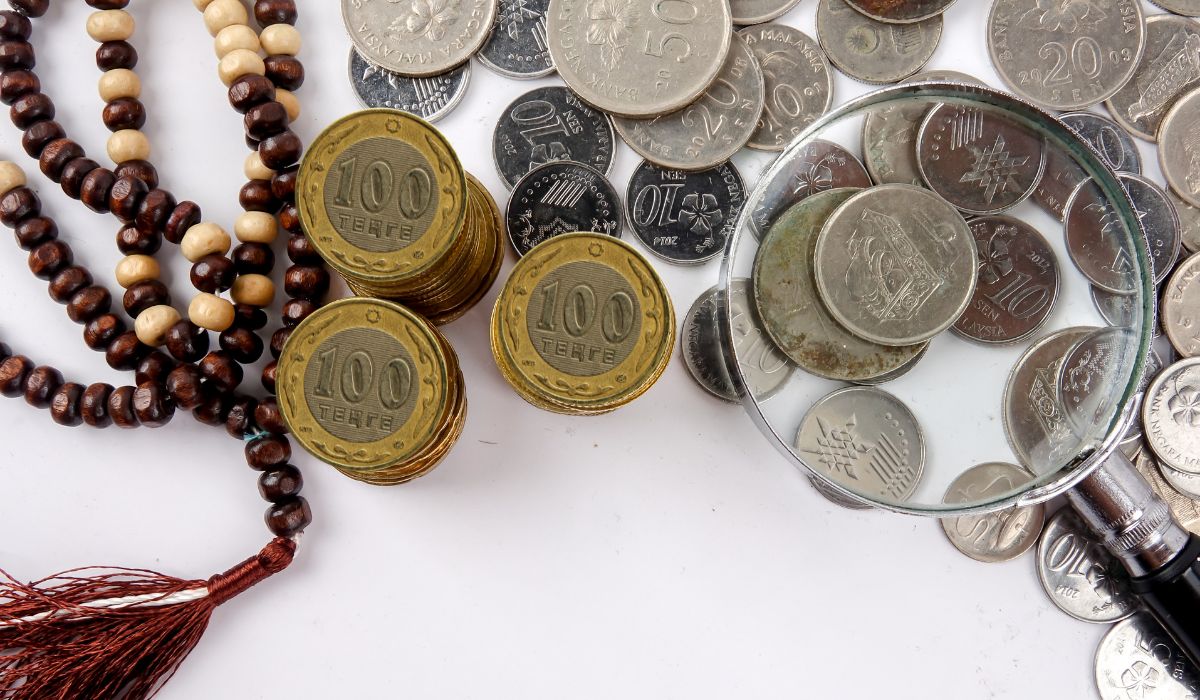
Despite ongoing controls and restrictions, the Islamic factor in Central Asia continues to grow in significance. At the same time, the contemporary re-Islamization of the region differs substantially both from the classical political Islamism of the twentieth century and from Middle Eastern models.
Today, the Islamization of Central Asia is above all a social, cultural, moral, and civilizational process.
Across all countries of the region, the number of practicing Muslims continues to increase. The halal economy is expanding, Islamic symbolism is becoming part of everyday culture, and interest in religious education is steadily growing.
Particularly important is the emergence of a new urban Muslim stratum composed of:
• entrepreneurs;
• students;
• professionals;
• bloggers, influencers, and other representatives of the emerging digital class.
In Kazakhstan, Uzbekistan, and to some extent Kyrgyzstan, a new Muslim urban milieu is taking shape. This environment is simultaneously:
• oriented toward a modern lifestyle;
• integrated into the global economy;
• and committed to preserving its religious identity.
Historically, it was precisely such social groups that formed the social base of:
• the early AKP (Justice and Development Party) in Turkey;
• Islamic modernization in Malaysia;
• and a number of other Islamically oriented projects, such as Tunisia’s Ennahda movement.
At the same time, Islam is rapidly expanding into the digital sphere. YouTube, Telegram, and social media platforms are increasingly becoming an alternative religious infrastructure. This development, however, has a dual effect.
On the one hand, the digital environment creates opportunities for new forms of Islamic education and public debate. On the other hand, it is often through these same channels that destructive groups and ideas presenting themselves as Islamic gain visibility and influence.
This situation is largely the result of the region’s lack of a developed Islamic intellectual ecosystem, institutions capable of cultivating it, and channels through which it can find public expression. As a consequence, the Islamic factor is frequently pushed into a marginal position, depriving society of constructive and intellectually grounded forms of Islamic engagement.
V. The Marginalization of Islam as a Continuation of the Colonial Condition
Post-Soviet regimes often present their policies as necessary measures to safeguard secular governance and preserve stability. In practice, however, many of these policies represent a continuation of the Soviet colonial logic.
Islam continues to be treated primarily as an object of control rather than as a legitimate component of social agency. This is reflected in:
• strict state control over mosques;
• restrictions on religious education;
• suspicion toward independent Islamic initiatives;
• and the securitization of the religious sphere as a whole.
Such policies carry serious consequences:
• they undermine the possibility of the emergence of a moderate Islamic public sphere;
• they contribute to the radicalization of segments of the Islamic environment—when all forms of Islamic autonomy become suspect, the resulting vacuum is gradually filled either by apolitical religiosity or by underground radical networks;
• and they deepen the growing divide between the state and society.
Post-Soviet elites continue to think in the categories of late Soviet secularism, while a significant portion of society increasingly views Islam as a vital source of morality, dignity, collective identity, and social justice.
As a result, the existing model is becoming progressively less sustainable.
VI. Dead-End Alternatives
The state-led marginalization of the Islamic factor has generated a variety of responses within society. However, the two most visible of these responses ultimately prove to be equally unproductive.
The Jihadist and “Shariatist” Dead End

One response to the marginalization of Islam and Muslim communities has been the rise of what may be described as radical Islamism, which presents the following alternatives to the existing order:
• the establishment of a “Sharia state”;
• the rejection of the nation-state framework;
• the denial of international law;
• a return to an idealized vision of the past.
Such projects are clearly destructive, including for the societies of post-Soviet Central Asia, which are characterized by:
• cultural pluralism;
• strong local traditions;
• the enduring importance of national identity;
• and a high degree of post-Soviet secularization.
Moreover, extremist projects almost invariably lead to:
• violence;
• the destruction of institutions;
• international isolation;
• and societal degradation.
To a significant extent, these movements are the product of the uncritical importation of marginal Middle Eastern ideological models that remain poorly rooted in the historical traditions of Central Asia.
The Dead End of New Atheism and Progressivism
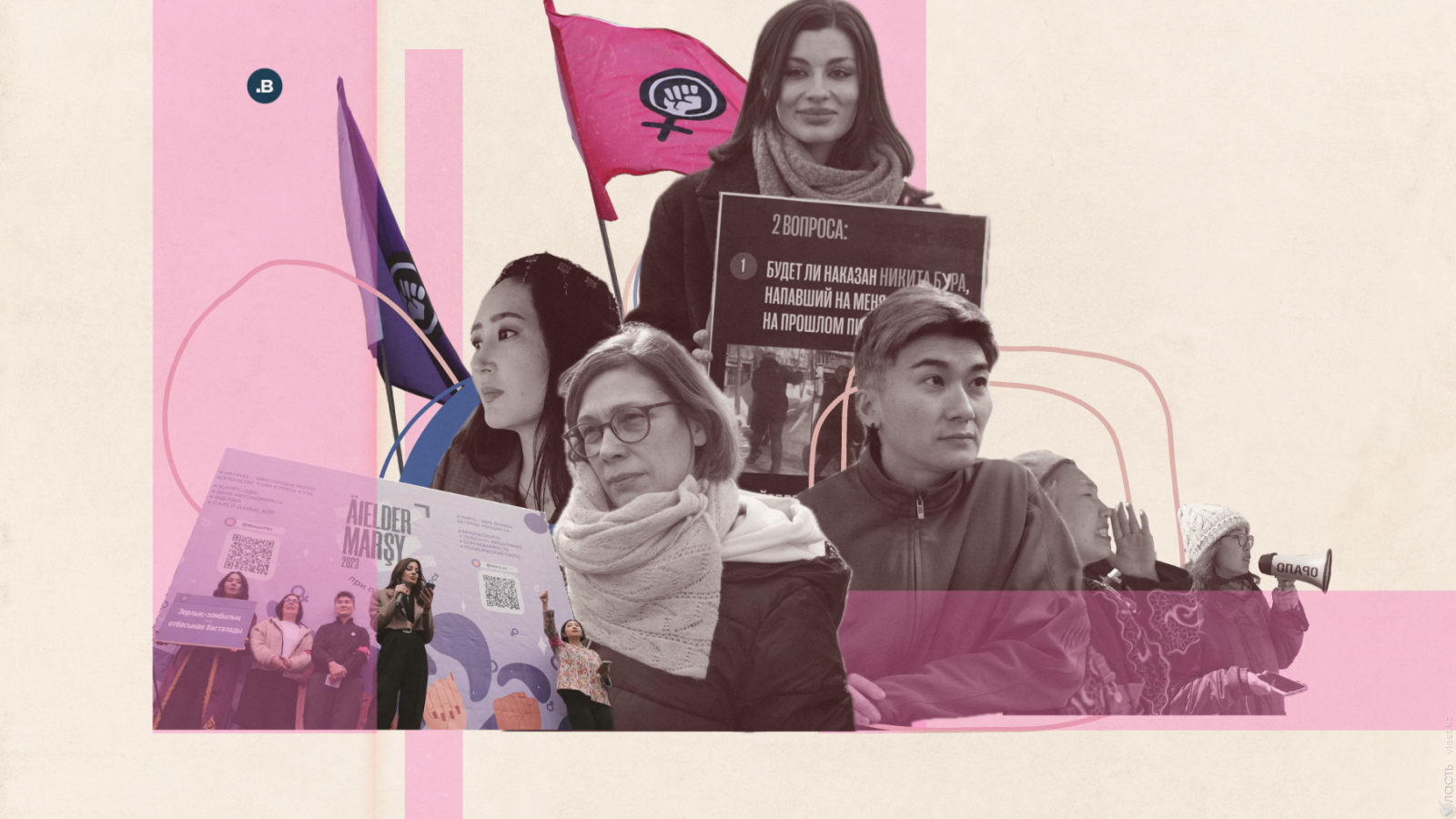
A different reaction has taken the form of aggressive secularism and anti-Islamism in its various manifestations. Because segments of the post-Soviet elite and urban intelligentsia tend to perceive any process of Islamization as a threat to modernity, a number of related phenomena have emerged:
• Islamophobia;
• cultural nihilism;
• radical progressivism;
• attempts to construct neo-pagan identities;
• attempts to deconstruct the core of the Islamic worldview through the promotion of post-Islamic doctrines such as so-called “Quranism.”
Yet this path also leads to a dead end because it:
• deepens the cultural divide between elites and society;
• reproduces the colonial logic that treats religious and traditional culture as obstacles to development;
• contributes to the radicalization of the religious sphere by turning Islam into a language of cultural resistance.
In this sense, both radical Islamism and aggressive secular anti-Islamism reinforce one another. Each derives its strength from the failures of the other, while neither offers a viable framework for the long-term development of Central Asian societies.
VII. The Potential for Islamic Renewal
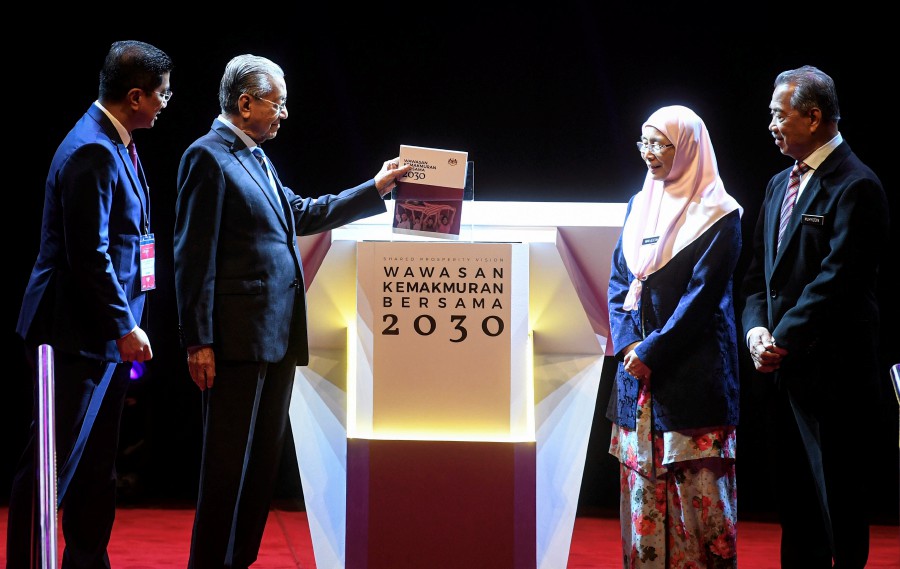
Despite all existing constraints, international experience demonstrates that Islamic identity is not inherently incompatible with modernization, development, or modern institutions. On the contrary, it can serve as a foundation for all three. The most important examples in this regard are Turkey, Tunisia, and Malaysia.
The early AKP (Justice and Development Party) in Turkey succeeded in combining:
• religious conservatism;
• market-oriented modernization;
• infrastructure development;
• the emergence of a new middle class;
• and the curtailment of military authoritarianism.
Importantly, the Turkish experience was not built around the idea of an “Islamic state.” On the contrary, the early AKP advanced a model of “conservative democracy” and moral modernization.
Tunisia’s Ennahda movement went even further, seeking to reconcile Islamic identity with pluralism, constitutionalism, and political compromise.
Malaysia under Mahathir demonstrated the possibility of Islamic-inspired modernization and development through the combination of:
• technological advancement;
• national capitalism;
• modernization;
• and cultural authenticity.
While these models differ significantly from one another, they share a common feature: all sought to transform Islam not into a language of prohibition and resentment, but into a source of civilizational development.
In each of these cases, Islamic identity functioned not as an obstacle to progress, but as a moral and cultural framework through which modernization could be legitimized and socially embedded. Their experiences suggest that the central challenge is not whether Islam and modernity can coexist, but how the relationship between them is articulated and institutionalized.
For Central Asia, these examples are significant not because they can be mechanically replicated, but because they demonstrate the possibility of an alternative path—one that avoids both the authoritarian secularism inherited from the Soviet era and the utopianism of radical Islamist projects.
VIII. Preconditions and Constraints in Central Asia
In post-Soviet Central Asia, certain preconditions for the emergence of indigenous forms of Islamic modernization already exist.
First, a new urban Muslim stratum is taking shape across the region.
Second, there is a growing demand for:
• social justice;
• moral politics;
• the fight against corruption;
• and a more dignified form of public life.
Third, interest in the region’s own intellectual traditions is increasing, including Jadidism, Islamic enlightenment, and the heritage of Transoxiana.
At the same time, significant constraints continue to impede the development of these trends. The most important of these is not merely the absence of a legal Islamic public politics, but the suppression of even the earliest manifestations of its emergence.
Moreover, the region continues to suffer from a shortage of:
• a developed Islamic intellectual environment;
• modern Muslim think tanks;
• educational institutions capable of moving beyond “traditional” Islamic education while incorporating the most advanced global intellectual and educational trends;
• and a vibrant Muslim civil society.
For this reason, the most likely short-term form of Islamic renewal is not the emergence of a political party, but the gradual formation of a new Muslim public sphere.
IX. Umranism as a Project of Civilizational Renewal
The Essence of Umranism
The need for a new language of social development is becoming increasingly evident across Central Asia.
For a significant portion of society, the language of liberal democracy is associated with:
• external interference;
• cultural Westernization;
• and the chaos of the 1990s.
The language of “radical Islamism,” by contrast, is associated with:
• violence;
• utopianism;
• and the destruction of the state.
The region therefore requires an alternative framework, and Umranism may provide such a framework.
In the context of Central Asia, Umranism can be understood as a project of:
• ethical modernization;
• civilizational development;
• social justice;
• cultural revival;
• and nation-building,
grounded in the foundational Islamic values embodied in the maqāṣid al-sharīʿa.
Umranism does not require:
• “theocracy”;
• an “Islamic state”;
• or the dismantling of secular institutions.
On the contrary, it presupposes:
• strong institutions;
• educational development;
• technological modernization;
• urban development;
• support for entrepreneurship;
• and social solidarity.
Within this framework, Islam functions not as an instrument of total social control, but as a source of:
• ethics;
• dignity;
• responsibility;
• and civilizational memory.
In many respects, Umranism can be understood as a form of twenty-first-century Jadidism. Just as the Jadids of the early twentieth century sought to reconcile:
• Islamic tradition;
• education;
• technological advancement;
• and social renewal,
so too does Umranism seek to reconnect the region’s Islamic heritage with the demands of contemporary development.
In this sense, a new Umranist project could offer Central Asia its own model of modernity—neither a Western imitation nor an extremist utopia.
Practical Implementation
It is important to recognize, however, that under the current conditions prevailing in the countries of PSCA, Umranism cannot develop as a conventional political project.
In most states of the region, any attempt to establish an organized Islamic political movement would almost inevitably be perceived by the authorities as a security threat. Consequently, the primary task is not the immediate creation of parties or political fronts, but the gradual cultivation of the cultural, intellectual, and social infrastructure necessary for a future Islamic renewal.
For this reason, a depoliticized Islamic civil society must play the central role.
The objective is neither the creation of underground organizations nor engagement in revolutionary mobilization. Rather, it is the pursuit of a long-term strategy of civilizational and intellectual influence.
In this regard, a useful parallel can be drawn with the role played by émigré communities from the communist countries of Eastern Europe and the Soviet republics during the second half of the twentieth century. The most influential émigré circles were not engaged in organizing armed uprisings. Instead, their mission was to create:
• alternative intellectual environments;
• independent cultural infrastructures;
• new languages of public discourse;
• and sustained forms of moral pressure on existing systems.
A similar strategy may prove to be the most realistic path forward for Central Asia as well.
Within the region itself, the space for autonomous Islamic politics remains extremely limited. Nevertheless, opportunities still exist for the gradual development of:
• a Muslim public sphere;
• a new intellectual elite;
• professional networks;
• and civic initiatives.
Particularly important in this regard is the development of socially and economically oriented projects.
An Umranist milieu could emerge around:
• educational initiatives;
• urban development projects;
• charitable activities;
• professional associations;
• Islamic business ethics;
• the development of the halal economy;
• family and youth policy initiatives;
• support for entrepreneurship;
• and local community development.
Such initiatives need not be explicitly identified as political or oppositional. On the contrary, in most cases their sustainability will depend precisely on their ability to remain within the framework of:
• social development;
• national dialogue;
• modernization;
• and cultural renewal.
At the same time, such a milieu would inevitably acquire long-term political significance, because it is through these structures that there emerge:
• new elites;
• horizontal networks of cooperation;
• capacities for self-organization;
• and alternative social imaginaries.
The Potential Role of the Central Asian Diaspora
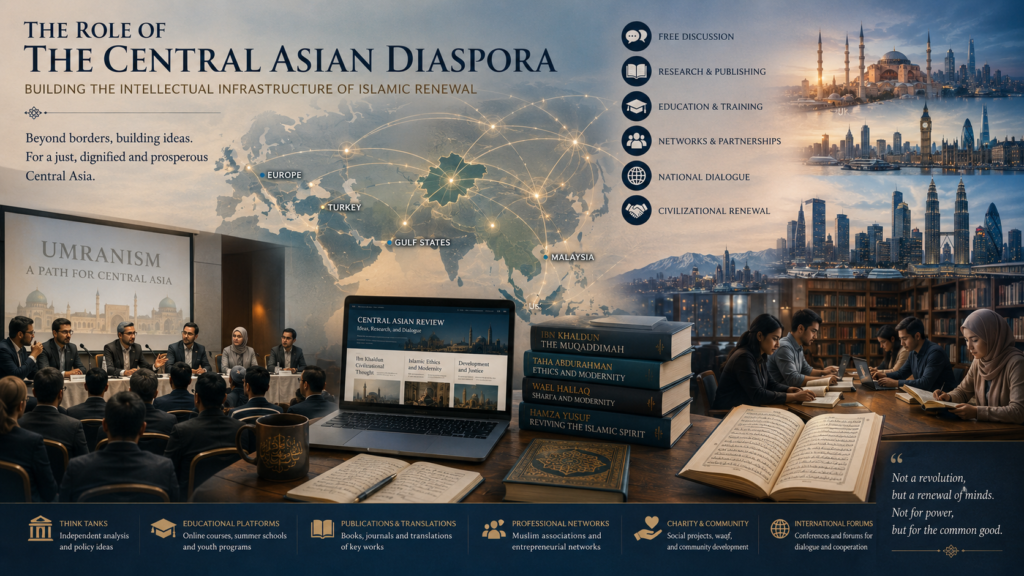
While Muslims within the countries of PSCA should, at this stage, pursue a strategy of principled depoliticization of their activities—which, in the long term, constitutes a carefully calibrated political strategy in its own right—the region’s political diasporas can assume responsibilities that remain difficult or impossible to undertake at home.
Turkey, continental Europe, the United Kingdom, Malaysia, and, to some extent, the Gulf states can serve as platforms for the emergence of a new Central Asian intellectual environment.
It is outside the region that relatively greater opportunities currently exist for:
• free discussion;
• publishing activities;
• independent research;
• educational initiatives;
• and international engagement.
Particularly important may be the creation of a network of conferences and forums dedicated to:
• contemporary Islamic thought, including the intellectual legacy of Ibn Khaldun and the work of leading contemporary thinkers such as Taha Abdurrahman, Wael Hallaq, Hamza Yusuf, and others;
• the development of Central Asia;
• strategic planning;
• urbanism;
• education;
• technology;
• social policy;
• Islamic ethics;
• and questions of cultural and civilizational identity.
It is essential that such initiatives not be presented as oppositional projects. Their purpose should not be the creation of a revolutionary milieu, but the formation of a space for national dialogue. Only under such conditions can they attract participation not only from opposition figures and independent experts, but also from:
• policy-oriented experts associated with state institutions;
• foreign public officials;
• entrepreneurs;
• religious intellectuals;
• members of the diaspora;
• and independent researchers.
Such a strategy is particularly important because the societies of Central Asia remain, on the whole, relatively conservative and strongly oriented toward stability. Most citizens do not seek revolution or the destruction of the state. At the same time, there is a growing demand for:
• dignity;
• justice;
• lower levels of corruption;
• greater social mobility;
• and a more ethical form of public life.
It is around these concerns that an Umranist milieu can gradually take shape.
In practical terms, this could involve:
• the establishment of think tanks;
• educational platforms and online courses;
• summer schools;
• programs for training young intellectuals;
• translation initiatives;
• the publication of literature on Islamic modernism and Jadidism;
• Muslim professional associations;
• urban and architectural projects;
• discussion clubs;
• research grants;
• networks of young entrepreneurs;
• charitable foundations;
• and international conferences.
No less important is the creation of a new public language. Umranism should speak not about the “seizure of power” or the creation of a “Sharia state,” but about:
• development;
• dignity;
• justice;
• quality education;
• strong institutions;
• cultural renewal;
• and a flourishing society.
This is precisely what distinguishes Umranism from both radical Islamism and post-Soviet secular authoritarianism. In the long run, such a strategy may prove far more influential than attempts at direct political confrontation. Its objective is not revolution, but the gradual transformation of public consciousness, the formation of new elites, and the cultivation of an indigenous model of Islamic modernity.
Conclusion
Central Asia today finds itself at a historic crossroads. The Soviet model of secular authoritarianism is gradually losing its ability to provide a convincing framework for social development, while radical Islamist alternatives offer little more than political utopianism and social fragmentation. Neither path provides an adequate response to the region’s growing demand for dignity, justice, cultural authenticity, and meaningful modernization.
The central challenge facing post-Soviet Central Asia is therefore not the presence of Islam, but the absence of a viable model through which Islamic identity can be reconciled with development, modern institutions, and social progress. As long as Islam remains confined either to a tightly controlled official sphere or to marginal and oppositional spaces, this challenge will remain unresolved.
Umranism represents one possible attempt to formulate such a model. Rooted in the Islamic civilizational tradition while oriented toward the future, it seeks to reconnect ethical values, cultural continuity, and social solidarity with modernization, education, technological advancement, and institutional development. In this sense, it can be understood as a twenty-first-century successor to the reformist aspirations of the Jadids.
