
Author: Sharofiddin Gadoev,
President of the Foundation for the Defense of Democracy in Central Asia
Tajikistan is one of the most religiously homogeneous countries in the post-Soviet space. Current estimates suggest that between 97 and 99 percent of the population identify as Muslim. Of these, approximately 90–95 percent are Sunni adherents of the Hanafi school, while around 3–5 percent belong to the Ismaili branch of Shia Islam. The latter are largely concentrated in the Gorno-Badakhshan Autonomous Region (GBAO), creating a distinct regional dimension in the country’s confessional structure.
Non-Muslim religious communities are extremely small. They include Orthodox Christians (primarily among the Russian-speaking population), as well as Protestants, Catholics, and small communities of Baha’is, Jews, and others. Their combined number is estimated at several tens of thousands, or less than 1–2 percent of the population.
At the same time, formal religious affiliation does not necessarily correspond to levels of religious observance. While the overwhelming majority identify as Muslim, the degree of religious practice varies significantly. A substantial share of the population can be described as “cultural Muslims,” for whom religious identity is primarily social and traditional rather than devotional. Regular practices—such as daily prayers, attendance at Friday congregational services, or the wearing of the hijab—are observed by a more limited segment of society.
The country’s religious landscape also displays regional variation. Western and central regions—including Dushanbe, Sughd, and Khatlon—are almost entirely Sunni, whereas GBAO represents a unique case of Ismaili predominance. In addition, elements of localized religious practice, particularly those associated with Sufi traditions, persist in rural and mountainous areas.
Taken together, Tajikistan can be characterized as a society with an almost universal Islamic identity, but with significant internal variation in religious practice and regional patterns.
Religion in Tajikistan Over the Past Two Decades
Given the effectively mono-confessional—though regionally differentiated—composition of Tajik society, the development of a free and inclusive civil society is unlikely without avenues for constructive religious expression among the country’s Muslim population. This is reinforced by the fact that, for a significant portion of society, Islam serves as a central component of identity and worldview. Moreover, Islamically oriented actors played an active role in Tajikistan’s struggle for independence in the late twentieth century.
Against this backdrop, the government’s approach to Islam and its adherents is particularly revealing. State policy has been consistently characterized by restrictive and repressive measures aimed at controlling religious life.
The tightening of state policy toward Islam and practicing Muslims coincided with Emomali Rahmon’s shift away from post-civil war national reconciliation and toward the consolidation of a more overtly authoritarian system. In the religious sphere, this shift has been underpinned by several key legal measures:
- the 2007 Law “On the Regulation of Traditions, Celebrations, and Ceremonies,” which imposes strict controls not only on religious observances but also on broader social events—such as weddings and funerals—where religious elements may be present;
- the revised 2009 Law “On Freedom of Conscience and Religious Associations,” which effectively prohibits religious activity outside state registration and oversight;
- amendments to the Law “On Combating Extremism” (from 2011 onward), which expand the powers of security agencies and increase penalties for violations in the religious sphere;
- the 2011 Law “On Parental Responsibility for the Upbringing of Children,” which severely restricts religious education within families and, with limited exceptions, prohibits individuals under the age of 18 from attending mosques or participating in religious activities;
- Supreme Court bans on various Islamic movements and organizations, including the Muslim Brotherhood (2006), Salafism (2009), and the Islamic Renaissance Party of Tajikistan (2015).
As a result, tens of thousands of practicing Muslims in Tajikistan have been affected by state repression. This includes individuals:
- prosecuted on religiously framed criminal charges;
- currently serving prison sentences;
- forced into exile due to fears of religious persecution.

Tajikistan can therefore be characterized not only as an authoritarian and repressive regime, but also as a state that systematically excludes or marginalizes openly religious citizens—despite the fact that Islam constitutes a core element of identity for the overwhelming majority of the population.
Historical Drivers of the Regime’s Hostility Toward Islam
The regime’s adversarial approach to Islam in Tajikistan is rooted both in its own political origins and in the history of its relationship with Tajik civil society. Before examining these factors, however, it is necessary to outline the historical role of Islam in Tajik society.
Islam Among Tajiks Prior to Soviet Rule
Islam has been present in the territory of present-day Tajikistan for over a millennium. For most of this period, the region formed part of the broader cultural and intellectual space of Transoxiana, one of the historical centers of Islamic civilization. As early as the medieval period, this region played a key role in the development of Islamic theology, jurisprudence, and philosophy.
By the nineteenth and early twentieth centuries, on the eve of Soviet rule, Islam constituted a comprehensive foundation of social life. Within the Emirate of Bukhara, which encompassed much of the region, Islamic law regulated a significant share of legal relations, while religious scholars (ulama) and judges (qadis) played an active role in governance and the administration of justice.
By the early twentieth century, Islam in Tajik society operated across several interconnected levels:
- an extensive network of mosques and madrasas;
- functioning religious courts;
- a waqf system (religious endowments);
- widespread Sufi brotherhoods—particularly the Naqshbandi Order—which formed durable social networks.
The major centers of religious education were Bukhara and Samarkand, which trained religious scholars for the wider region. In this context, Islam served as the primary foundation of identity and social organization among Tajiks in the pre-Soviet period.
Islam in Tajikistan Under Soviet Rule
Following the Bolshevik takeover of Muslim-majority territories under the banner of global socialist revolution, the new authorities launched a systematic campaign against Islam as a central component of social identity, culture, and everyday life in the region.
During the 1920s and 1930s, Soviet anti-religious policies included:
- the closure and destruction of thousands of mosques;
- the elimination of madrasas;
- the confiscation of waqf property;
- the abolition of Islamic courts;
- arrests, deportations, and executions of religious scholars and leaders;
- the dismantling of traditional religious elites;
- the suppression of religious education;
- the persecution of informal channels of knowledge transmission.
By the late 1930s, Islam as an institutional system had been almost entirely removed from the public sphere in Tajikistan.
During World War II, Soviet policy underwent a limited adjustment. The authorities established the Spiritual Administration of Muslims of Central Asia and Kazakhstan as an official channel for managing relations with Islam. Religious practice was permitted, but only in a highly restricted form:
- it was tightly controlled by the state;
- it was limited to a small number of officially registered mosques;
- independent religious activity was not tolerated.
Despite these restrictions, Islam remained deeply rooted in Tajik society. The Soviet authorities were unable either to eliminate it entirely or to bring it fully under state control. As a result, particularly after the death of Joseph Stalin and the subsequent loosening of centralized repression, a dual structure emerged in Tajikistan, characterized by the coexistence of official and informal religious spheres.
The official sphere included:
- a limited number of registered mosques;
- state-loyal clergy;
- strict government oversight.
The informal sphere included:
- household-based religious practices;
- informal religious leaders;
- underground networks of religious education.
By the late Soviet period, Islam in Tajikistan had taken on a paradoxical character. On the one hand, it had been stripped of its institutional base and largely excluded from public life. On the other, it remained deeply embedded in everyday practices and the social fabric of society.
This combination—destroyed institutions alongside persistent social religiosity—became a key precondition for the rapid re-emergence of Islam in the public sphere in the late 1980s.
The Revival of Islam in the Late Soviet and Perestroika Period
At the onset of perestroika, Islam in the Tajik SSR was institutionally marginalized but remained socially resilient. By the mid-1980s, the official religious infrastructure had been reduced to a minimum: only around 15–20 mosques were formally registered across the republic, and religious education had effectively disappeared. The only legal center for clerical training was the Mir-i Arab madrasa in Bukhara, which served the entire Central Asian region.
Beyond the official system, however, a much broader informal sector persisted. Hundreds of unregistered mullahs, home-based study circles, and durable networks of religious knowledge transmission sustained Islamic traditions. By the end of the Soviet period, Islam in Tajikistan functioned primarily as an “underground” social practice—lacking institutional expression but deeply embedded in everyday life.
Reforms in the second half of the 1980s fundamentally altered this situation. The weakening of state control, combined with glasnost and the gradual liberalization of religious policy, created conditions for previously suppressed practices to enter the public sphere. Between 1985 and 1988, informal religious activity expanded, accompanied by early signs of self-organization among Islamic groups.
A turning point came in 1989–1991, when a rapid religious revival took place. The adoption of the 1990 USSR law on freedom of conscience legalized religious activity and significantly expanded opportunities for institutional development. This led to an unprecedented growth in religious infrastructure: from roughly two dozen mosques in 1987 to approximately 3,000–4,000 by 1991. This 150–200-fold increase reflected not only the construction of new religious sites but, more importantly, the mass legalization of previously existing ones.
At the same time, religious education began to expand. By the early 1990s, dozens of informal schools were operating within the country, while hundreds of young Tajiks were traveling abroad—to Iran, Pakistan, and the Middle East—for religious studies. This contributed to the emergence of a new generation of religiously educated actors, distinct from traditional “folk” clergy.
The revival of Islam was accompanied by its rapid re-entry into the public sphere. Religious gatherings, lectures, study circles, and discussions on Islamic ethics, law, and social order became visible elements of public life. Collective prayers, fasting, and other religious practices were widely revived. Islam ceased to be confined to the private sphere and became a socially and politically salient force.
An important aspect of this transformation was a shift in the nature of religiosity itself. Whereas late Soviet religiosity had been largely informal and traditional, the late 1980s saw growing interest in more normative and “purified” forms of Islam. A new religious intelligentsia began to emerge, the role of preachers and teachers expanded, and the range of interpretations widened—partly under the influence of transnational connections.
By the end of the 1980s, religious revival was taking on increasingly organized forms. Stable networks and groups emerged, leaders with broad constituencies appeared, and religious activity extended beyond purely ritual practice. This period can be understood as a transition from diffuse religiosity to structured social mobilization.
At the turn of the 1990s, another qualitative shift occurred: the gradual politicization of Islam. In the context of ideological vacuum and the weakening of Soviet authority, religious networks began to perform functions beyond the spiritual sphere, including social mobilization and the articulation of collective interests.
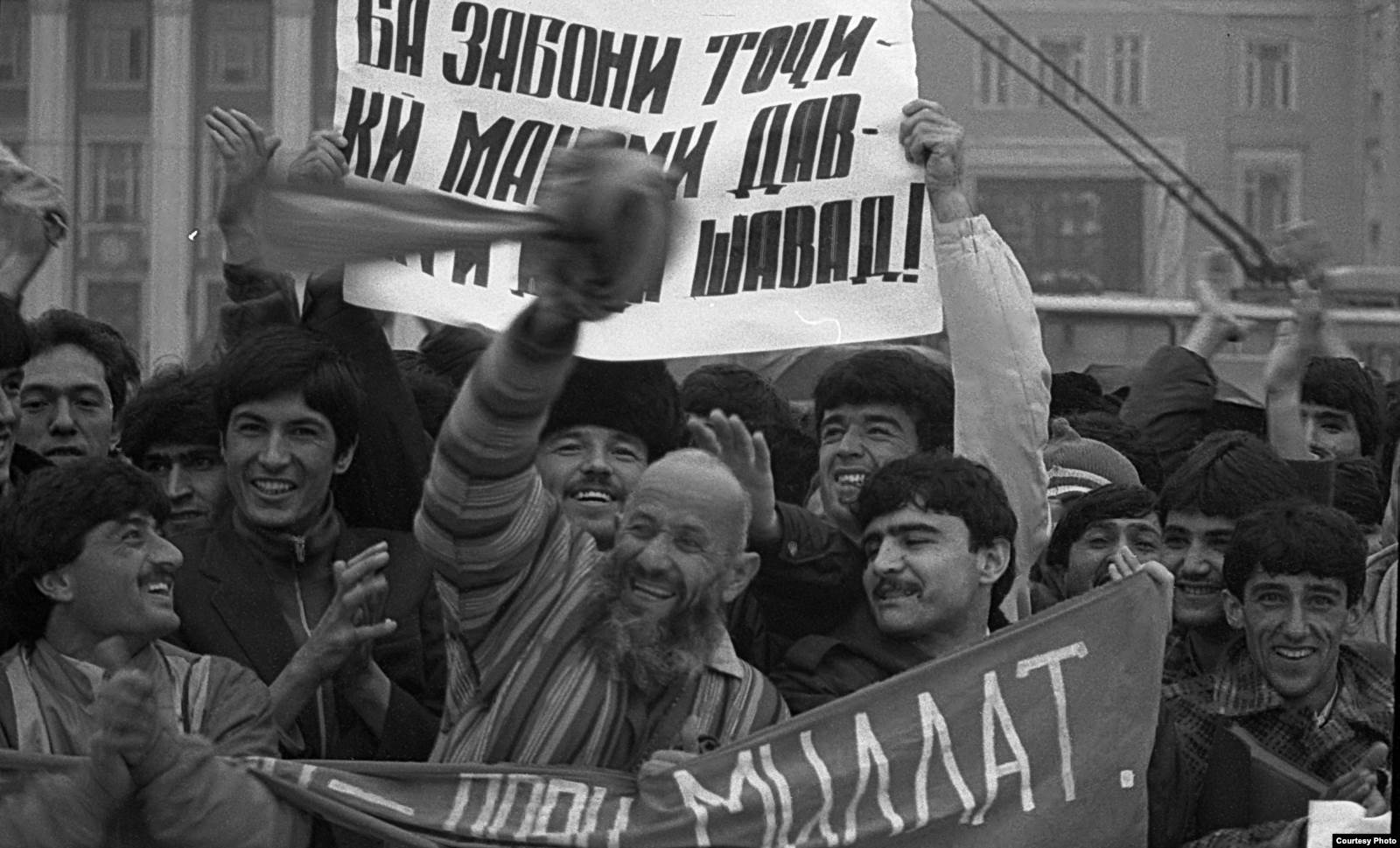
It was in this context that a movement emerged in 1990 that would later form the basis of the Islamic Renaissance Party of Tajikistan. At this stage, it functioned less as a conventional political party and more as a religious-social movement rooted in existing networks, the authority of religious leaders, and an expanding social base. Between 1990 and 1991, it consolidated organizationally, developed regional structures, and became increasingly involved in public and political life.
In sum, the Islamic revival in late 1980s Tajikistan can be understood as a process of rapid resocialization and institutionalization of religious life previously confined to the private sphere. Within a short period, the country moved from minimal official religious infrastructure to a mass and dynamic system in which Islam became a central element of social and public organization. This combination of institutional growth, social demand, and organizational development created the conditions for the emergence of Islamic movements that would play a visible role on the eve of the Soviet Union’s collapse.
The Role of the Islamic Opposition in the Civil War, the Peace Process, and the Dismantling of the Compromise
The Tajik Civil War provided the context in which Islamic movements first emerged as significant military and political actors. The Islamic Renaissance Party of Tajikistan (IRPT) did not operate in isolation but was part of the United Tajik Opposition (UTO), a coalition of Islamic, democratic, and regional forces. Within this coalition, the IRPT constituted the ideological and, to a significant extent, organizational core of the Islamic wing.
Although the party did not possess a fully centralized military structure, its supporters participated in UTO armed formations, particularly in the Rasht Valley and the Gorno-Badakhshan Autonomous Region. In a conflict that resulted, by various estimates, in 50,000 to 100,000 deaths and displaced up to one million people, Islam became an important instrument of mobilization and legitimation for the opposition. The IRPT played not only an ideological but also a representative role, acting as one of the key negotiating actors on behalf of the UTO.
A central figure of the Islamic wing was Sayid Abdullo Nuri, who combined the roles of party leader and chief negotiator. Other prominent figures included Muhammadsharif Himmatzoda, an important ideologue and organizer, and Akbar Turajonzoda, who provided religious legitimacy. At the same time, field commanders such as Mirzo Ziyoev controlled significant territories and maintained independent military bases. As such, the Islamic wing of the opposition functioned not as a single organization but as a network of actors ranging from political leaders to armed commanders.
The 1997 peace agreement marked a turning point, institutionalizing the participation of the opposition in the political system. Under its terms, up to 30 percent of government positions were to be allocated to opposition representatives, including the IRPT. The party was legalized and integrated into the political system: its members gained seats in parliament and positions within the state apparatus. In the early 2000s, the IRPT consistently received around 7–9 percent of the vote and maintained parliamentary representation, positioning itself as a moderate Islamic party operating within the constitutional framework.
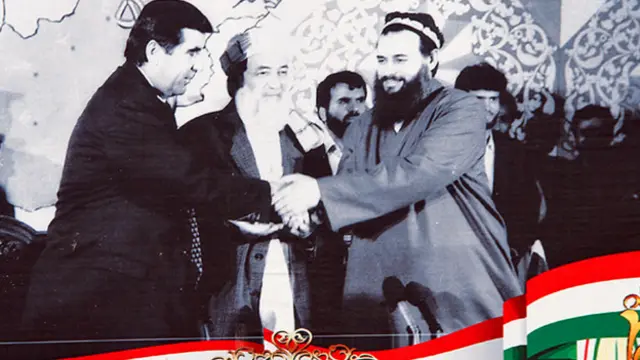
However, from the 2000s onward, this model of compromise was gradually dismantled. The first phase involved the marginalization of former field commanders. A notable example is Mirzo Ziyoev, who, after being integrated into the state system as Minister of Emergency Situations, later fell out with the central authorities and was killed during a security operation in 2009. Similarly, Abdullo Rahimov, associated with more radical elements of the former opposition, was eliminated in 2011. These cases illustrate a systematic effort to remove autonomous armed actors.
At the same time, pressure on the political wing intensified. Throughout the 2000s and early 2010s, the IRPT faced administrative barriers, restricted media access, and a shrinking political space. Its parliamentary representation was significantly reduced after the 2010 elections, and in 2015 the party failed to enter parliament for the first time, effectively losing its institutional foothold.
The decisive break came in 2015, when the authorities accused the IRPT leadership of involvement in an attempted coup. Shortly thereafter, the party was banned and designated an “extremist organization.” This was followed by a large-scale repressive campaign: party leader Muhiddin Kabiri was forced into exile, while key figures inside the country—including Saidumar Husayni and Mahmadali Hait—were arrested and sentenced to long prison terms, including life imprisonment. Dozens of party officials were prosecuted, and thousands of supporters fled the country.
At the same time, religious authorities were pushed out of the public sphere. Figures such as Akbar Turajonzoda were not directly repressed but were effectively marginalized and stripped of political influence.
The dismantling of the postwar compromise thus unfolded in several stages: from the neutralization of former commanders in the 2000s, to the exclusion of the IRPT from the political system in the early 2010s, and finally to its complete criminalization and ban in 2015. As a result, not only a single political actor but the entire infrastructure of Islamic opposition built in the 1990s was eliminated.
In a broader perspective, this process reflects the transformation of Tajikistan’s political system from a post-conflict model with elements of inclusion to a consolidated authoritarian regime based on the monopolization of power and the elimination of alternative centers of political and social mobilization. Within such a framework, Islam is structurally perceived as a potential threat, requiring containment through repression and comprehensive state control over practicing Muslims.
The Ideological Foundations of the Post-Soviet Regime and the Prospects for Democratization in Tajikistan’s Religious Dimension
The current regime’s approach to practicing Muslims is shaped not only by its conflictual experience with Islamic-oriented forces, through which it tends to interpret Islam broadly as a threat to its rule. It is also rooted in the ideological foundations of the regime itself.
The political order consolidated under Emomali Rahmon emerged in the early 1990s with the support of Russia and the regime of Islam Karimov in Uzbekistan, as Soviet-era elites united against reformist forces in Tajikistan. This consolidation was not only clan-based but also ideological, grounded in a distinctly Soviet identity. As discussed above, in the Tajik context this identity was constructed in opposition to Islam and shaped by an assertive form of secularism.
This Soviet-derived, Islamophobic identity distinguishes the Rahmon regime from several other post-Soviet systems, which—despite their Soviet origins—have sought to distance themselves from that legacy. In Azerbaijan, for example, the Soviet period is officially framed as one of occupation, a position reflected both in constitutional discourse and in broader state memory policies.
By contrast, Rahmon has continued to articulate a markedly different view. He has stated that Tajikistan, having spent seventy years within the Soviet Union, “adopted many principles of a civilized society and a secular way of life,” in contrast to countries of the Islamic East. This formulation is revealing in several respects:
- it presents the Soviet period in explicitly positive terms;
- it frames secularization as a key achievement of that period;
- it positions Tajikistan as comparatively advantaged vis-à-vis the Islamic world.
Claims about the superiority of the Soviet developmental path over that of the Islamic world require little scrutiny in light of contemporary socio-economic realities. Patterns of labor migration alone point to a very different hierarchy of opportunity.
At the same time, the neo-Soviet orientation of the Rahmon regime leaves it ideologically distant not only from the Islamic world but also from the institutional models of developed democracies, rule-of-law systems, and pluralistic civil societies in the West. By contrast, since the late Soviet reform period—and through the civil war and its aftermath—key segments of Tajik society have articulated a demand for a synthesis between democratic governance and their own civilizational identity, which remains closely linked to the Islamic world.
In this context, any meaningful process of transformation and democratization in Tajikistan will require a broad-based social consensus. Such a consensus is unlikely to emerge either from a strictly religious political model—such as that currently pursued by Taliban in Afghanistan—or from the rigidly secular and exclusionary framework that prevails today.
A more viable pathway would resemble models found in Turkey or Pakistan, where competitive multi-party systems, judicial independence, and media pluralism coexist with the public recognition of Muslim identity and its legitimate expression—without undermining constitutional order or national cohesion.
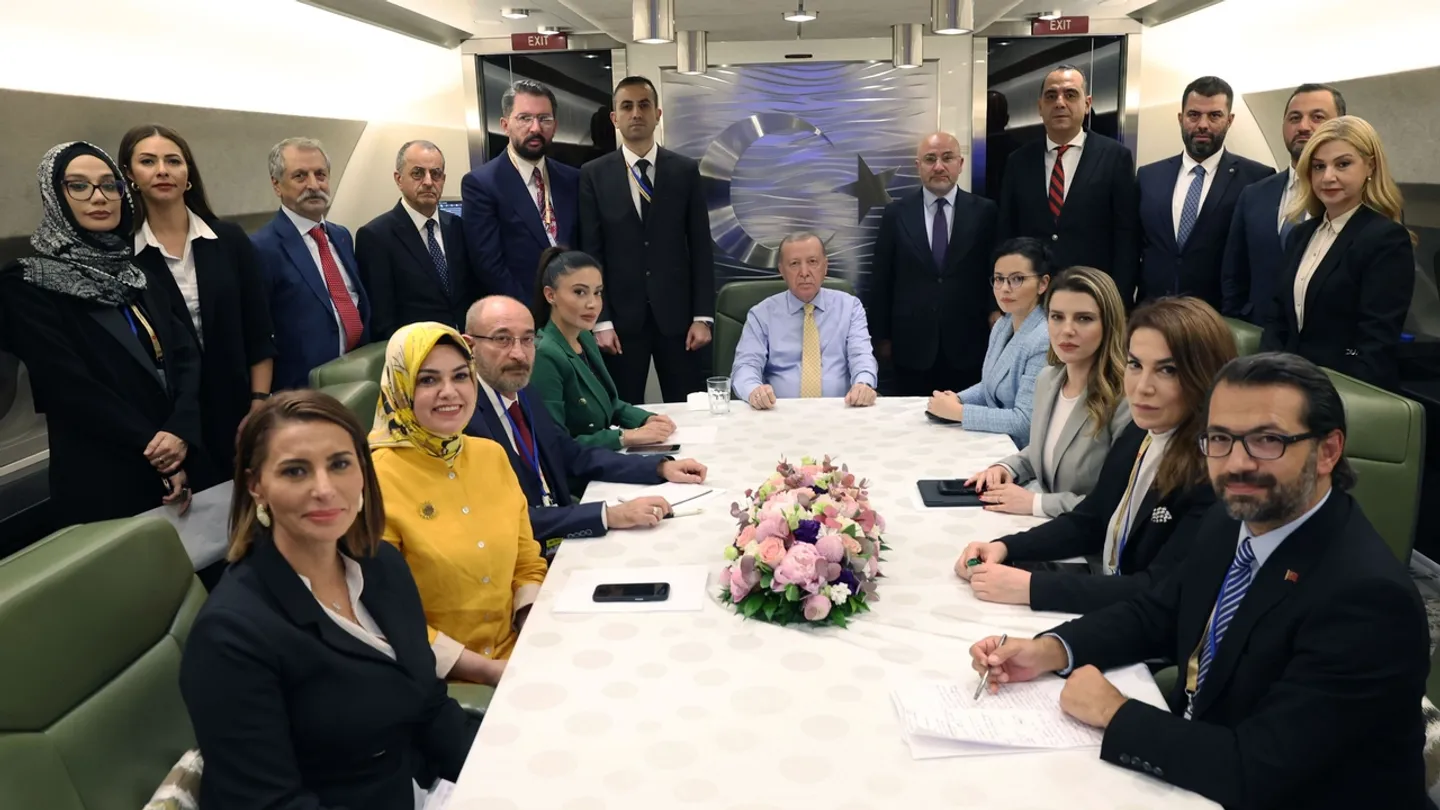
Achieving such a balance will require a willingness among all constructive actors within Tajik civil society—both more religious and more secular—to engage in dialogue and compromise. The development of a platform for such engagement remains one of the key objectives of the Foundation for the Defense of Democracy in Central Asia.
