
Analytical Group of the Foundation for the Defense of Democracy in Central Asia
Introduction
In July 2026, Kazakh President Kassym-Jomart Tokayev made one of his strongest public statements on the Russia–Ukraine war since the beginning of the full-scale invasion. Standing alongside Vladimir Putin, he publicly called for an early end to the hostilities and a return to negotiations, making clear that the continuation of the war no longer served the interests of the region and that the conflict required a political rather than a military solution. The significance of this statement lay not only in its content but also in the context in which it was delivered. By voicing such a position in the presence of the Russian president—rather than from a Western platform—Tokayev sent a clear signal that Kazakhstan was unwilling to align unconditionally with Moscow’s position on Ukraine and remained committed to pursuing an independent foreign policy, even within the framework of its alliance with Russia.
At almost the same time, however, a series of developments began to cast doubt on the long-term sustainability of this approach. As the war has become protracted and the Russian economy has come under mounting pressure, Kazakhstan has assumed growing importance as a supplier of fuel and petroleum products, a partner in processing Russian crude oil, a logistics and financial hub, and a potential destination for the relocation of Russian businesses. In other words, Kazakhstan is gradually becoming one of the key external sources of Russia’s economic resilience.
This is the central paradox of Kazakhstan’s current position. Politically, Astana has become increasingly determined to distance itself from the most controversial aspects of Russian policy. Economically, however, evolving market realities are drawing the country ever deeper into processes that objectively strengthen Russia’s ability to withstand the pressures of a prolonged war. If this trend continues, an unavoidable question arises: can a state consistently advocate ending a war while simultaneously playing an increasingly important role in cushioning its economic consequences for one of the belligerents?
This paper argues that the room for Kazakhstan’s traditional multi-vector foreign policy is steadily shrinking. During the first years of the war, balancing relations with Russia, China, the European Union, the United States, and Türkiye generated significant political and economic dividends for Astana. As the conflict has dragged on, however, this strategy has begun to produce contradictions that can no longer be managed through diplomacy alone.
On the one hand, Ukraine and its allies cannot indefinitely ignore Russia’s growing dependence on external sources of economic resilience. As Kazakhstan’s role expands in fuel supplies, logistics, financial services, and the relocation of Russian businesses, pressure on Astana is bound to increase. This pressure will not stem from any desire to undermine relations with Kazakhstan, but from the strategic logic of a prolonged war, in which constraining the adversary’s economic capacity becomes just as important as achieving success on the battlefield.
On the other hand, Russia has its own reasons to expect greater political and economic solidarity from Kazakhstan. In Russian political thinking, the January 2022 unrest and the deployment of CSTO forces remain a powerful symbol of Moscow having come to the aid of the Kazakh leadership at a critical moment. At the same time, the Kremlin cannot fail to notice Astana’s consistent efforts to pursue a more independent foreign policy, develop alternative transport corridors, deepen cooperation with the European Union, Türkiye, and China, and refrain from supporting some of Russia’s most sensitive foreign policy initiatives. Consequently, even closer economic cooperation with Moscow is unlikely to dispel Russia’s growing doubts about Kazakhstan’s long-term strategic orientation.
Kazakhstan is therefore increasingly caught between two competing centers of pressure. Continued participation in strengthening Russia’s economic resilience raises the likelihood of sanctions and diplomatic pressure from Ukraine and its partners. Yet reducing such cooperation would inevitably entail economic costs and heightened political risks in Kazakhstan’s relations with Moscow.
The central argument of this paper is that Kazakhstan should not become a mechanism for Russia’s economic rescue. At the same time, it would be equally misguided to expect Astana to abandon economically beneficial cooperation with Russia without offering a credible alternative. If Ukraine and its allies seek to prevent Kazakhstan from becoming one of the pillars of Russia’s economic resilience, they must also be prepared to help offset the costs of that choice. This requires moving beyond a strategy based primarily on the threat of sanctions toward one that combines targeted pressure with economic compensation, investment, expanded access to global markets, and new opportunities for long-term development. Only such an approach can simultaneously reduce Russia’s ability to rely on Kazakhstan as an economic lifeline while reinforcing Kazakhstan’s long-term strategic autonomy.
I. From Multi-Vector Foreign Policy to a Strategic Dilemma
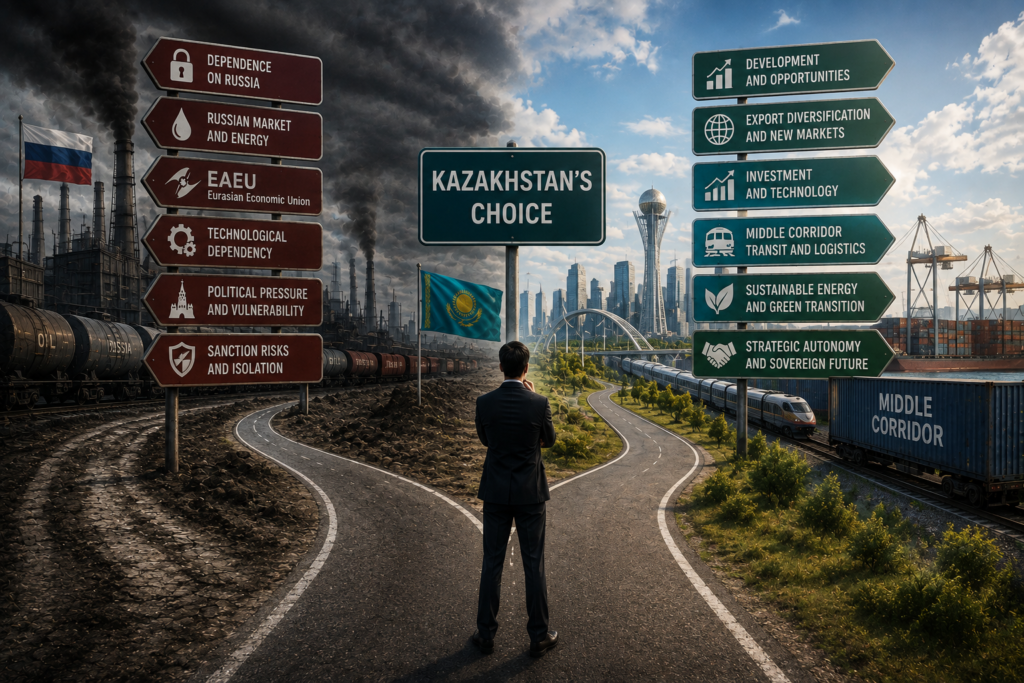
For more than three decades after gaining independence, Kazakhstan consistently pursued a foreign policy based on the principle of multi-vectorism. Its essence was not equidistance from the world’s major centers of power, but rather the simultaneous cultivation of mutually beneficial relations with Russia, China, the West, Türkiye, and other regional partners, while avoiding excessive dependence on any single actor. This strategy enabled Kazakhstan to capitalize on its geopolitical position, attract investment from diverse sources, diversify its external economic ties, and preserve considerable freedom of diplomatic maneuver.
The Russia–Ukraine war, which began in 2022, did not immediately undermine this model. On the contrary, during the first years of the conflict, Kazakhstan’s multi-vector policy generated additional political and economic advantages. Seeking to avoid direct involvement in the confrontation, Astana refused to recognize Russia’s territorial annexations in Ukraine, maintained working relations with Kyiv and Western governments, while continuing cooperation with Moscow through the Eurasian Economic Union (EAEU), the Collective Security Treaty Organization (CSTO), and bilateral agreements. This approach allowed Kazakhstan to preserve its reputation as a relatively neutral actor and avoid a serious deterioration of relations with any of the parties involved.
As the war became protracted, however, the very nature of Kazakhstan’s multi-vector policy began to change. What initially served as a mechanism for balancing among competing centers of power has increasingly come up against structural constraints created by a changing strategic environment. The longer the war continues, the fewer areas remain in which cooperation with Russia can be viewed solely as a matter of bilateral economic relations. A growing number of such interactions now have direct implications for Russia’s ability to adapt to the consequences of war, international sanctions, and damage to its industrial and energy infrastructure.
As a result, Kazakhstan’s economic engagement with Russia is gradually taking on a different character. Fuel supplies, petroleum refining, transport and logistics projects, financial intermediation, the relocation of Russian businesses, and other forms of cooperation are no longer merely commercial ventures. In the context of a prolonged war, they are increasingly becoming components of Russia’s broader system of economic resilience.
This does not mean that Kazakhstan has consciously set out to support Russia’s wartime economy. Most of these decisions are driven by ordinary commercial considerations and serve the immediate interests of Kazakh businesses and the national budget. In international politics, however, outcomes matter as much as intentions. When particular forms of economic cooperation enable Russia to offset the damage caused by sanctions and military action, they inevitably become viewed through the prism of security rather than commerce alone.
It is precisely here that a new strategic dilemma emerges—one that fundamentally distinguishes the current stage of the war from its earlier phases. As long as the scale of such cooperation remained limited, Ukraine and its allies could regard it as an inevitable consequence of geographic proximity and longstanding economic interdependence between the two countries. As Russia’s reliance on external sources of economic resilience continues to grow, however, perceptions of these ties are changing accordingly. What was once viewed as ordinary bilateral economic cooperation is increasingly seen as a factor affecting Russia’s capacity to sustain the war.
Kazakhstan therefore finds itself in a position where preserving its traditional model of multi-vector diplomacy is becoming progressively more difficult. Expanding economic cooperation with Russia exposes Astana to growing political and sanctions-related pressure from Ukraine and its allies. Reducing such cooperation, by contrast, entails unavoidable economic costs and additional political risks in its relations with Moscow. In other words, multi-vectorism is gradually ceasing to be an unqualified strategic asset and is instead becoming a source of mounting strategic costs.
The central question facing Kazakhstan today is therefore no longer whether it should choose between Russia and the West. The more fundamental challenge is how to preserve its strategic autonomy at a time when the two principal directions of its foreign policy are placing increasingly incompatible demands upon it.
II. Kazakhstan’s Growing Role in Sustaining Russia’s Economic Resilience
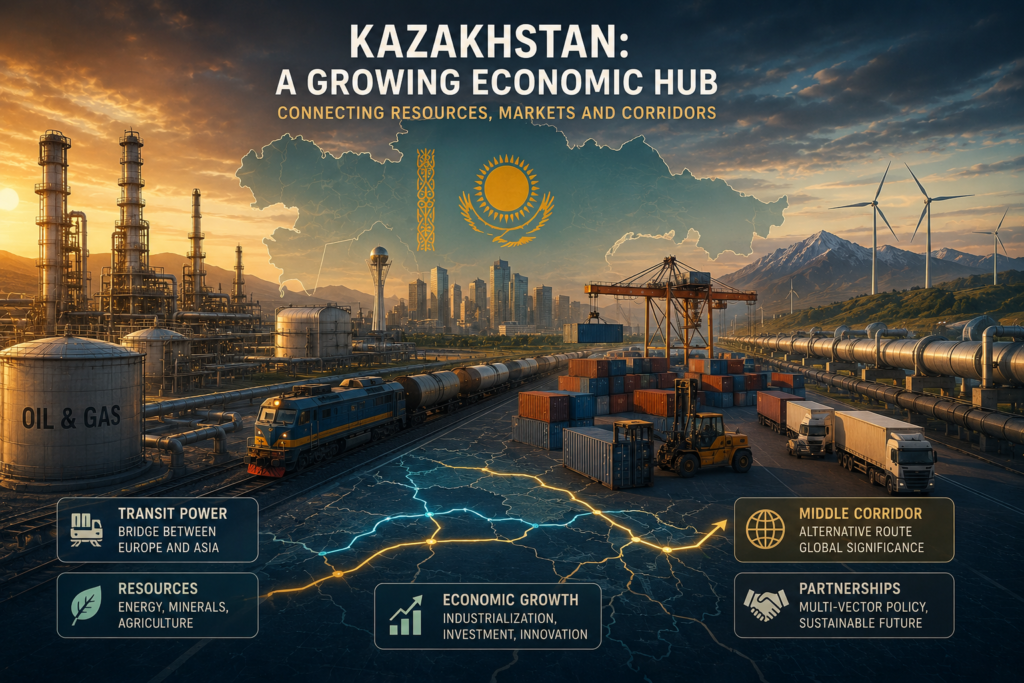
Until recently, economic cooperation between Russia and Kazakhstan was generally viewed as a natural consequence of geographic proximity, shared infrastructure, and integration within the Eurasian Economic Union (EAEU). Developments in 2025–2026, however, point to a qualitative shift in the nature of this relationship. Whereas Kazakhstan initially helped Russia adapt to the sanctions regime, it is now gradually assuming functions whose strategic importance has grown precisely because of the war and the weakening of key sectors of the Russian economy.
The Fuel Crisis and Kazakh Petroleum Products
This trend became particularly evident in the summer of 2026. A series of Ukrainian strikes on Russian oil refineries significantly reduced gasoline and diesel production, drove up domestic fuel prices, and caused shortages in several Russian regions. As a result, the Russian government was forced to curb fuel exports while simultaneously seeking alternative sources of supply.
At this point, Kazakhstan began to play the role of an external stabilizer of Russia’s fuel market. Moscow approached Astana with a request to supply gasoline, with the two sides discussing imports of approximately 50,000 tonnes of fuel before the first commercial deliveries of Kazakh gasoline to Russian regions took place. At the same time, Kazakhstan entered negotiations on processing Russian crude oil at its own refineries, with part of the refined petroleum products subsequently being sold back to the Russian market.
From a purely commercial perspective, such arrangements are entirely rational. Kazakhstan benefits from higher refinery utilization rates and increased revenues. Strategically, however, their significance extends well beyond ordinary trade. In effect, they represent a partial transfer of Russia’s oil-refining functions to the territory of a neighboring state at a time when Russia’s own refining infrastructure is coming under increasing pressure as a result of the war.
Logistics and Transit
Transport and logistics constitute another area of growing strategic importance. The extensive land border between the two countries, the EAEU’s common customs space, and an integrated railway network make Kazakhstan one of Russia’s most important partners in maintaining external trade links.
As trade with European markets has become increasingly constrained, Kazakhstan’s transport corridors have gained greater importance for Russia’s connections with Central Asia and China. At the same time, Kazakhstan remains a pivotal participant in the Trans-Caspian International Transport Route, or Middle Corridor. This creates a strategic paradox: the same infrastructure can simultaneously contribute to reducing Central Asia’s dependence on Russia while also helping Russia adapt to its increasingly constrained external economic environment.
The Relocation of Russian Business
Another emerging trend is the gradual relocation of selected functions of Russian businesses to Kazakhstan. This is not primarily about moving entire companies, but rather about transferring warehouse facilities, logistics operations, IT services, subsidiary legal entities, and other elements of corporate infrastructure.
The most visible example has been the debate surrounding Wildberries’ expanding presence in Kazakhstan and the possible relocation of part of its operations there. Regardless of the eventual scale of these plans, the broader trend is strategically significant. Kazakhstan is increasingly being used by Russian businesses not only as a consumer market but also as a more stable jurisdiction from which to maintain access to international trade and reduce sanctions-related risks.
Financial and Corporate Infrastructure
A similar pattern is emerging in the financial and corporate sphere. Kazakh banks, logistics providers, and corporate structures are increasingly being used by Russian businesses as elements of an external infrastructure that enables them to sustain international operations. This extends beyond financial transactions to company registration, the facilitation of export-import activities, and the organization of cross-border supply chains.
Taken individually, each of these mechanisms may appear relatively limited. Collectively, however, they are creating an additional layer of resilience for the Russian economy, allowing it to offset, at least in part, the effects of sanctions and the disruption of key production and supply chains.
Russia’s Emerging Dependence
It is important to emphasize that these developments do not reflect a fundamental shift in Kazakhstan’s foreign policy orientation. On the contrary, Astana has remained broadly consistent in its political stance: it has refused to recognize Russia’s annexation of Ukrainian territories, continues to advocate a diplomatic settlement of the conflict, and remains committed to its multi-vector foreign policy.
The logic of a prolonged war, however, is gradually reshaping economic realities. The greater the damage inflicted on Russia’s infrastructure and the more constrained the Russian economy becomes, the more valuable become those states capable of compensating for these losses. In this sense, Kazakhstan’s growing strategic importance is determined less by its political declarations than by the structural requirements of Russia’s wartime economy.
This constitutes the most significant qualitative change of recent years. Whereas between 2022 and 2024 Kazakhstan primarily helped Russia adapt to the sanctions regime, by 2026 there are increasing signs that it is becoming an integral component of Russia’s broader system of economic resilience. This is no longer merely an extension of longstanding bilateral economic cooperation. It represents a new strategic reality—one that is likely to shape not only Ukraine’s policy toward Kazakhstan, but also the broader approach adopted by Ukraine’s allies.
III. Where Is the Line Between Normal Economic Cooperation and Becoming Russia’s Economic Lifeline?
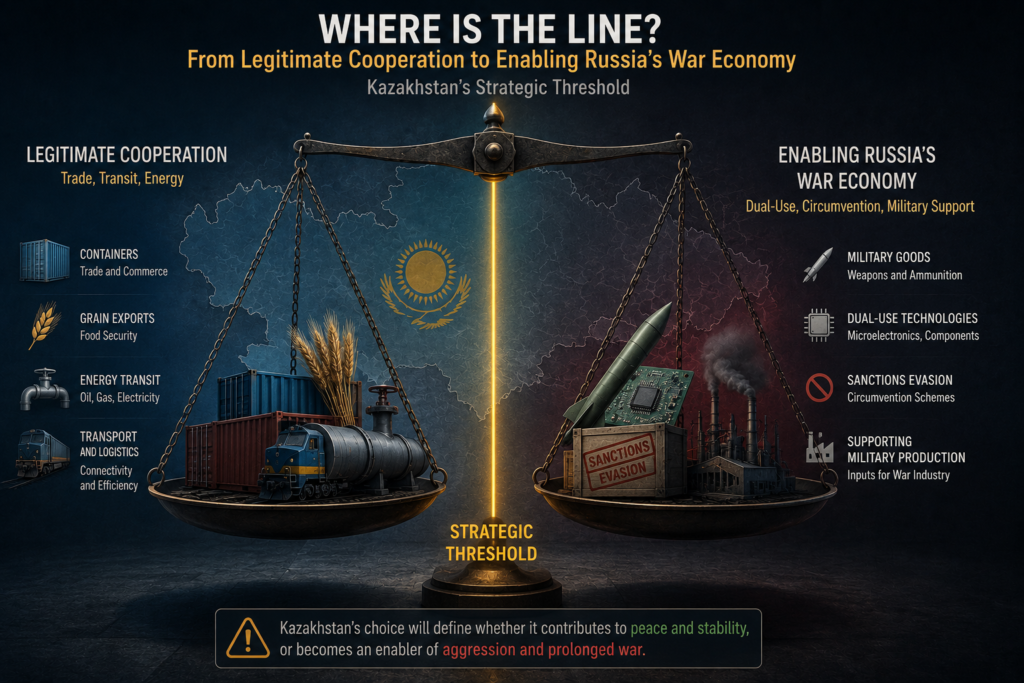
One of the most difficult questions arising from Russian-Kazakh economic relations is where to draw the line between legitimate cooperation between two neighboring states and activities that significantly enhance Russia’s economic resilience during a prolonged war.
Drawing such a distinction is far from straightforward. Russia and Kazakhstan share one of the world’s longest land borders, have spent decades developing an integrated economic space, and remain members of the Eurasian Economic Union (EAEU). A complete severance of economic ties is not only practically impossible but would also run counter to Kazakhstan’s own national interests. Moreover, such a demand would be neither realistic nor consistent with established international practice.
The issue, therefore, should be framed differently. The objective is not to end economic cooperation with Russia as such, but to prevent the emergence of forms of cooperation that enable Russia to offset the costs imposed by war and sanctions or sustain critical elements of its wartime economy.
This paper proposes distinguishing between three levels of economic engagement.
Level One: Normal Economic Cooperation
The first category includes trade in consumer goods, mutual investment, cross-border economic cooperation, transport infrastructure projects, energy cooperation unrelated to mitigating the effects of the war, and other forms of interaction that long predate the Russia–Ukraine conflict.
Such activities do not, in themselves, increase Russia’s ability to wage war and therefore should not become the target of political pressure or sanctions. Attempts to restrict this type of cooperation would not only damage Kazakhstan’s economy but would also create the impression that Ukraine and its allies seek to dismantle the broader model of regional economic integration rather than address the specific challenges posed by the war.
Level Two: Dual-Use Economic Cooperation
The second category is considerably more complex. It includes projects that are commercially legitimate while simultaneously carrying strategic implications.
Examples include the processing of Russian crude oil, expanded fuel supplies during periods of shortage, the relocation of selected functions of Russian companies, the use of Kazakhstan’s financial and logistics infrastructure, and certain forms of industrial cooperation.
Individually, each of these activities may be economically rational and fully consistent with international law. Collectively, however, they begin to strengthen Russia’s economic resilience under wartime conditions.
This category should therefore become the primary focus of political dialogue among Kazakhstan, Ukraine, and Western partners. The priority should not be immediate pressure, but rather the search for practical solutions that would enable Kazakhstan to scale back the most strategically sensitive forms of cooperation without incurring disproportionate economic costs.
Level Three: Supporting Russia’s Wartime Economy
The third category encompasses activities that directly contribute to Russia’s ability to sustain its war effort.
These may include mechanisms designed to compensate for fuel shortages resulting from Ukrainian strikes on Russian infrastructure, schemes to circumvent sanctions on goods critical to Russia’s defense-industrial base, the creation of alternative financial mechanisms serving the Russian military sector, or the transfer to Kazakhstan of economic functions whose loss would directly weaken Russia’s capacity to continue the war.
This is the category that should become the object of consistent countermeasures by Ukraine and its allies.
Even here, however, the principal instrument should not be a policy of punishing Kazakhstan as a state. Rather, efforts should focus on targeted measures directed at specific projects, companies, and financial mechanisms that are of strategic importance to Russia’s wartime economy.
From Sanctions to a Strategy of Strategic Incentives
This distinction has fundamental implications for the policy choices facing Ukraine and its partners.
If every form of Russian-Kazakh economic cooperation is treated as equally unacceptable, pressure will inevitably become indiscriminate. Such an approach would force Kazakhstan to choose between significant economic losses and closer dependence on Russia. Under these circumstances, Astana’s ability to sustain its multi-vector foreign policy would inevitably erode.
A more effective strategy would focus exclusively on those forms of cooperation that materially enhance Russia’s economic resilience. Restrictions on the most strategically significant projects should therefore be accompanied by investments, support for alternative transport corridors, expanded access to Western markets, technological cooperation, and other measures designed to offset Kazakhstan’s economic costs.
The choice, therefore, should not be framed as one between sanctions and engagement. Instead, it should be understood as a combination of selective containment and strategic compensation. The more precisely pressure is directed at the mechanisms that sustain Russia’s wartime economy—and the more credible the economic alternatives offered to Kazakhstan—the greater the likelihood that Astana will be able to preserve its strategic autonomy without simultaneously becoming one of the principal pillars of Russia’s economic resilience.
IV. Why Ukraine Can No Longer Ignore Kazakhstan’s Growing Role
For much of the Russia–Ukraine war, Kyiv viewed Kazakhstan as a country pursuing a cautious yet broadly independent foreign policy. Astana’s refusal to recognize Russia’s annexation of Ukrainian territories, its continued working contacts with the Ukrainian leadership, and its efforts to avoid direct involvement in the conflict allowed Kazakhstan to be seen less as a supporter of Russia than as a relatively neutral partner.
As the war has become protracted, however, Ukraine’s strategic priorities have inevitably evolved. During the initial phase of the conflict, the primary focus was on military operations and securing international military assistance. Today, an equally important objective is to constrain the economic resources that enable Russia to sustain its war effort. Modern wars are won not only on the battlefield, but also through industrial production, energy, logistics, finance, and international trade. Consequently, reducing Russia’s economic resilience has become an increasingly central component of Ukraine’s overall strategy.
From this perspective, any external economic cooperation that enables Russia to offset the effects of sanctions, infrastructure damage, or disrupted supply chains inevitably acquires strategic significance. What matters is not the political declarations of Russia’s partners, but the practical impact of their economic activities on Russia’s ability to sustain military production, supply its armed forces, and maintain the functioning of its wartime economy.
This is why Kazakhstan’s role is gradually becoming an issue that extends well beyond bilateral relations with Russia. As Kazakhstan assumes a more significant role in supplying fuel, processing Russian crude oil, supporting logistics networks, providing financial services, or hosting relocated Russian business operations, these activities inevitably attract the attention of both the Ukrainian government and its international partners, regardless of the political motivations behind them.
At the same time, Ukraine’s room for maneuver is limited. Kyiv cannot afford to wait indefinitely to see how Kazakhstan’s policy evolves. Each additional year of war brings enormous human, economic, and infrastructural losses. Under such circumstances, Ukraine has a clear strategic interest in reducing, as quickly as possible, external factors that strengthen Russia’s economic resilience. The longer such mechanisms remain in place—or continue to expand—the more likely it becomes that Ukrainian policy will shift from observation to active countermeasures.
This does not mean that Ukraine has an interest in undermining its relationship with Kazakhstan. On the contrary, Kazakhstan’s independent foreign policy, its refusal to recognize changes to Ukraine’s internationally recognized borders, and its efforts to maintain constructive relations with Kyiv all serve the long-term interests of both countries. Precisely for this reason, however, Ukraine must distinguish between Kazakhstan as a state and the specific economic mechanisms that contribute to strengthening Russia’s wartime economy. The objective of Ukrainian policy should not be to weaken Kazakhstan, but to reduce those forms of cooperation that enable Russia to lower the economic costs of continuing the war.
This has important implications for Ukraine’s allies as well. Should pressure on Kazakhstan become necessary, it should not be conceived as a tool for punishment or for altering the country’s geopolitical orientation. Instead, it should be narrowly targeted at those forms of economic activity that materially enhance Russia’s ability to wage war. Any attempt to subject Kazakhstan to broad-based sanctions would almost certainly produce the opposite outcome—deepening Astana’s dependence on Moscow while narrowing the space for its independent foreign policy.
Ukraine therefore faces a complex strategic dilemma. On the one hand, it cannot afford to ignore Kazakhstan’s growing importance to the Russian economy. On the other hand, excessive pressure on Kazakhstan could push it into even closer alignment with Russia, thereby exacerbating the very problem Ukraine seeks to address.
This is the central paradox. The more important Kazakhstan becomes to Russia, the more strategically important it also becomes to Ukraine. Yet while Russia seeks to maximize the use of Kazakhstan’s economic potential, Ukraine’s objective is not to weaken Kazakhstan but to ensure that this potential is not used to sustain Russia’s wartime economy. The challenge, therefore, is not to isolate Kazakhstan, but to create conditions under which refraining from contributing to Russia’s economic resilience becomes the most rational strategic choice for Kazakhstan itself.
V. From the Politics of Pressure to a Strategy of Strategic Incentives
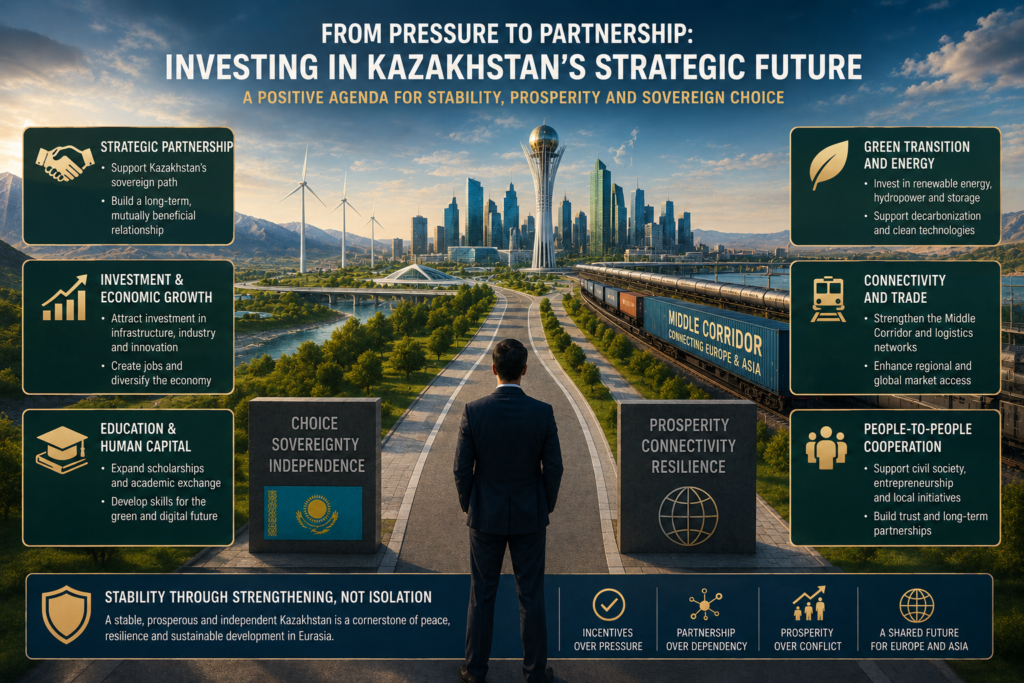
Ukraine and its allies therefore face a dual strategic challenge. On the one hand, they have a clear interest in preventing Russia from offsetting the economic costs of the war through deeper cooperation with Kazakhstan. On the other hand, preserving an independent, multi-vector Kazakhstan is itself a long-term strategic interest shared by Ukraine, Europe, and the broader Euro-Atlantic community. Any policy that pushes Kazakhstan into greater dependence on Russia will ultimately undermine both of these objectives.
This suggests that the traditional logic of sanctions-based pressure has inherent limitations. If Ukraine and its partners merely demand that Kazakhstan abandon economically beneficial cooperation with Russia without offering viable alternatives, they effectively force Astana to choose between its own national interests and the interests of the international coalition supporting Ukraine. For any sovereign state, such a choice is likely to be perceived as both inequitable and politically unsustainable.
The Russian factor must also be taken into account. Even if Kazakhstan agrees to scale back the most strategically sensitive forms of economic cooperation with Russia, Moscow is highly likely to respond. Russia possesses a broad range of economic, political, and informational instruments that can be used to pressure Kazakhstan. Moreover, Russian political discourse already reflects the view that Kazakhstan—having benefited from the CSTO intervention during the January 2022 unrest—owes Moscow greater political loyalty. Consequently, reducing Kazakhstan’s role in supporting Russia’s economic resilience would entail not only forgone commercial opportunities but also increased political risks in its relationship with Russia.
For this reason, limiting Kazakhstan’s contribution to Russia’s economic resilience cannot rely solely on the threat of sanctions. If the international community genuinely seeks such an outcome, it must also be prepared to help compensate for the costs that Kazakhstan would incur as a result.
This paper therefore argues for moving away from a strategy based primarily on negative incentives toward one centered on strategic incentives. Its underlying premise is that preserving Kazakhstan’s strategic autonomy is a valuable objective in its own right for European and Euro-Atlantic security. Assisting Kazakhstan in reducing its dependence on Russia should therefore be viewed not as economic assistance to a single country, but as an investment in a more resilient security architecture across Eurasia.
In practical terms, such a strategy should rest on several complementary pillars.
First, Ukraine’s allies should offer Kazakhstan long-term economic incentives capable of offsetting the reduction of the most strategically sensitive forms of cooperation with Russia. Rather than direct financial transfers, these should include investments in transport infrastructure, industrial development, value-added processing, the digital economy, and projects linked to the further development of the Middle Corridor.
Second, Kazakhstan should receive broader access to Western capital, technology, and investment. If reducing its role in sustaining Russia’s wartime economy is accompanied by expanded opportunities for cooperation with the European Union, the G7, and other democratic partners, such a course of action becomes significantly more attractive from the standpoint of Kazakhstan’s own national interests.
Third, sanctions policy itself should become considerably more targeted. Restrictive measures should focus not on Kazakhstan’s economy as a whole, nor on Russian-Kazakh economic relations in general, but on specific companies, financial institutions, and logistical networks that directly contribute to sustaining Russia’s wartime economy. Such an approach would reduce the risk of sanctions themselves becoming a driver of deeper Russian influence in Kazakhstan.
Finally, political dialogue must become a central element of this strategy. Ukraine and its allies should make it clear that they regard Kazakhstan not as part of the problem, but as a potential part of the solution. This requires regular consultations with the Kazakh leadership, the exchange of information on strategically sensitive areas of economic cooperation, and joint efforts to identify solutions that minimize risks both to Ukraine’s security and to Kazakhstan’s long-term strategic interests.
The strategy proposed in this paper is built upon a simple but fundamental principle: states cannot be expected to abandon economically beneficial policies unless they are offered more attractive alternatives. In an era of prolonged war and intensifying great-power competition, an approach based solely on sanctions and pressure will inevitably reach its limits. A more sustainable strategy is one in which reducing Kazakhstan’s role in sustaining Russia’s wartime economy is accompanied by expanding its opportunities for independent economic development, deeper integration with democratic partners, and greater long-term strategic autonomy.
VI. A Policy Roadmap: Preventing Kazakhstan from Becoming Russia’s Economic Lifeline
The analysis presented in this paper demonstrates that the central challenge lies not in Russian-Kazakh economic cooperation as such, but in its gradual transformation. As the war becomes increasingly protracted, certain forms of this cooperation are beginning to compensate for Russia’s economic losses, turning Kazakhstan into an increasingly important contributor to Russia’s economic resilience. At the same time, Astana itself faces growing difficulties in sustaining its traditional model of multi-vector foreign policy.
Under these circumstances, the objective of all interested parties should not be to dismantle Russian-Kazakh economic relations, but to prevent their evolution into a long-term mechanism for sustaining Russia’s wartime economy.
Recommendations for Kazakhstan
Kazakhstan should recognize that short-term economic gains must not come at the expense of its long-term strategic autonomy.
In practical terms, this would require:
- avoiding participation in projects that directly compensate for the damage inflicted on the Russian economy by the war and international sanctions;
- avoiding the transformation of Kazakhstan into the principal platform for relocating strategically important functions of Russian businesses;
- strengthening transparency in export controls and the regulation of dual-use goods;
- accelerating the development of alternative export routes and non-resource sectors of the economy;
- diversifying external economic relations so that dependence on the Russian market declines gradually through structural transformation rather than as a result of future crises.
The central conclusion for Kazakhstan is straightforward: serving as an economic stabilizer for Russia may generate limited short-term economic benefits, but it also creates long-term political, economic, and investment risks.
Recommendations for Ukraine
Ukraine should avoid treating Kazakhstan as a state that has aligned itself with Russia.
Instead, Ukrainian policy should clearly distinguish between Kazakhstan’s political position and specific forms of economic cooperation that strengthen Russia’s wartime economy.
This approach should include:
- maintaining sustained political dialogue with Astana;
- conducting joint assessments of the most strategically sensitive economic projects;
- focusing on the mechanisms that enhance Russia’s economic resilience rather than on Russian-Kazakh relations as a whole;
- expanding bilateral cooperation in areas unrelated to the war in order to lay the foundations for a stronger post-war partnership.
Recommendations for the European Union, the G7, and International Financial Institutions
This is the area where the most significant policy shift is required.
If Ukraine’s partners genuinely seek to reduce Kazakhstan’s role in sustaining the Russian economy, they must provide Astana with credible alternatives.
Such a package could include:
- long-term investment in the development of the Middle Corridor;
- support for the modernization of transport infrastructure;
- investment insurance and risk-mitigation mechanisms;
- expanded access for Kazakh exports to European markets;
- joint projects in critical minerals, energy, and the digital economy;
- increased financing for initiatives that strengthen Kazakhstan’s long-term economic independence.
The objective should not be financial assistance for its own sake. Rather, it should be to create conditions in which economic cooperation with democratic partners becomes more attractive for Kazakhstan than participation in sustaining Russia’s wartime economy.
Recommendations for Sanctions Policy
Greater selectivity should become the guiding principle of future sanctions policy.
Restrictive measures should focus primarily on:
- mechanisms used to circumvent export controls;
- supplies of goods and technologies that are critical to Russia’s wartime economy;
- companies that knowingly participate in offsetting the effects of damage inflicted on Russia’s strategic infrastructure;
- financial mechanisms that facilitate such activities.
At the same time, policymakers should avoid measures that would inflict disproportionate damage on Kazakhstan’s economy as a whole and thereby push the country toward even closer alignment with Russia.
Conclusion
The Russia–Ukraine war is gradually reshaping not only the balance of power between the two belligerents but also the strategic position of states seeking to preserve their foreign policy autonomy. Kazakhstan has emerged as one of the clearest examples of this transformation. For more than three decades, its multi-vector foreign policy enabled Astana to balance successfully among competing centers of power. Today, however, that strategy is facing new constraints as the war itself transforms economic relations into an integral part of a broader geopolitical confrontation.
Under these circumstances, Kazakhstan faces an increasingly difficult strategic choice. By expanding its participation in projects that help offset Russia’s economic losses, it risks gradually eroding the confidence of Ukraine and its allies while exposing itself to mounting political, economic, and reputational costs. At the same time, stepping back from such a role would inevitably entail the loss of certain economic benefits and greater political pressure from Moscow.
For this reason, the long-term strategy of Ukraine and its partners should not be limited to constraining Russia’s ability to use Kazakhstan as a source of economic resilience. It should also seek to preserve Kazakhstan’s own strategic autonomy. These objectives are not contradictory. On the contrary, they are mutually reinforcing.
The less Kazakhstan depends on serving as an economic stabilizer for Russia, the more independent its own foreign policy will become. Likewise, the more Ukraine and its allies are prepared to invest in facilitating this transition, the greater the likelihood that Kazakhstan will preserve its multi-vector foreign policy—not merely as a balancing strategy among competing powers, but as the foundation of a genuinely sovereign foreign policy.
