
By the Analytical Group of the Foundation for the Defence of Democracy in Central Asia (FDDCA)
The approval by President Donald Trump of a new U.S. National Security Strategy in November 2025, together with the events in Venezuela in January 2026, may prove to be turning points marking the transition from the first to the second quarter of the 21st century.
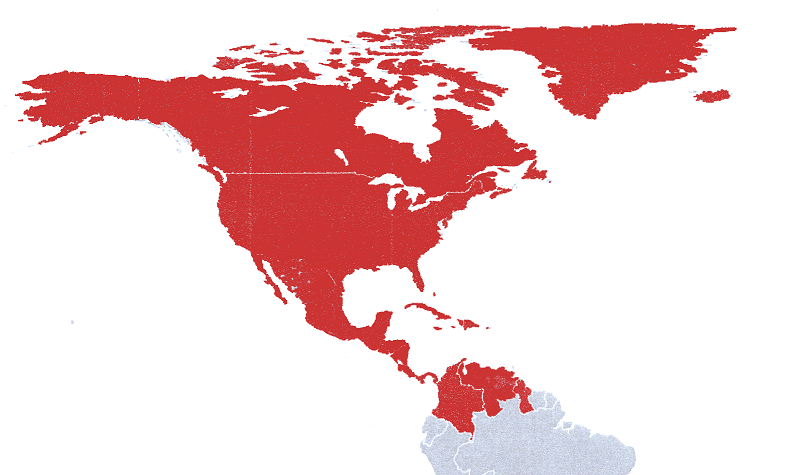
The U.S. National Security Strategy (hereafter — the U.S. Strategy) explicitly speaks of Washington’s shift toward a Monroe Doctrine in Trump’s interpretation (“The Trump Corollary to the Monroe Doctrine”). Therefore, it is important to understand both what the original Monroe Doctrine was and what its reinterpretation by President Trump may entail.
The Monroe Doctrine: Historical Background

The Monroe Doctrine refers to the ideological concept formulated in 1823 by U.S. President James Monroe in his address to Congress. Its message to the world essentially amounted to the thesis: “America for the Americans, Europe for the Europeans.” However, understanding it requires a brief historical context.
The American continent — “Greater America” — was colonized by settlers from Europe, who eventually distributed themselves as follows:
- Anglophone populations — the present-day United States and Canada (except French-speaking Quebec), that is, central and northern North America;
- Latin-language populations (primarily Spanish- and Portuguese-speaking) — all of South America and the southern part of North America (Mexico), and in a cultural sense even French-speaking Quebec.
The United States and Canada represent an Anglophone continuum in North America that became politically divided when part of the Anglo-American population (the future Americans) chose independence from the British Crown, while others (the Canadians) remained loyal and later expanded autonomy to near-independence (dominion status).
At the same time, the southern territories of the modern United States had to be conquered: in the Mexican-American War of 1846–1848, which resulted in the acquisition of California, and in the Civil War of 1861–1865 against the Confederacy, which attempted to separate the southern states.
South American countries, although they gained independence from Spain and Portugal as the U.S. did from Britain, retained certain cultural and linguistic ties (for example the doctrine of Hispanidad).
The proclamation of the Monroe Doctrine was intended to close the entire Western Hemisphere to external powers — at the time primarily Spain and Portugal, and to some extent Britain and France, which had supported U.S. adversaries. The very name of the country — the United States of America — and the self-designation “Americans,” despite representing only part of the hemisphere’s population, reflected this ideology. The situation of Indigenous peoples across the Americas stands apart as a separate issue.
In subsequent eras the Monroe Doctrine was used both to counter external (initially European and later Soviet) influence in the Western Hemisphere and to consolidate U.S. dominance within it. Externally it could be presented in two ways:
- as a continental isolationist approach — America stays out of Europe’s affairs and Europe out of America’s;
- or as justification for U.S. dominance in the hemisphere without renouncing global engagement.
The Trump Monroe Doctrine: Possible Interpretation
To understand the modern context, it is necessary to note the current position of the United States and its rivals:
- California and other southern states conquered in the 19th century have become centers of continuous mass immigration, including illegal migration from Latin America, changing the demographic and cultural-linguistic character of the country;
- during the Cold War the United States assumed leadership of the entire Western (Euro-Atlantic) world under NATO and after the Cold War effectively the leading global power;
- in competition with the U.S., powers such as China and Russia have actively built alliances with anti-American governments in Latin America.
Under these conditions, the provisions of the U.S. Strategy regarding Trump’s Monroe Doctrine and statements by American leaders may indicate one of two possibilities:
- The United States concentrates on strengthening its position throughout the Western Hemisphere and the Pacific region, even at the cost of reducing alliance commitments elsewhere;
- The United States simultaneously strengthens its position in the Americas and Pacific while maintaining alliances and activity beyond them.
Relations with Denmark-Greenland and Canada will serve as a decisive test:
- an attempt at forced annexation of Greenland or Canada would indicate the first scenario, potentially destroying NATO and transatlantic relations;
- coordination with NATO partners would indicate the second scenario — continued global engagement.
The Threat of a “Kremlin Doctrine” to Post-Soviet States

The future of regions including Central Asia and the South Caucasus (5+3) will significantly depend on how Trump’s Monroe Doctrine is implemented.
U.S. strikes against the Maduro regime in Venezuela and possible future actions against similar regimes in Cuba or Colombia, as well as seizures of Russian tankers trading oil in violation of sanctions, have dealt sensitive blows to Moscow.
At the same time, voices in Russia are calling for support of the doctrine — interpreted as recognition of U.S. control over the Western Hemisphere while granting Russia a similar sphere of influence.
Russia’s ultimatum to NATO before the invasion of Ukraine — demanding NATO rollback to 1997 positions — demonstrates that Moscow still views even Central-Eastern Europe as its sphere. While Russia might accept “Finlandization” there, it considers the post-Soviet space a zone of direct military-political domination.
A revealing statement came from Kremlin propagandist Vladimir Solovyov after the fall of pro-Russian regimes in Syria and Venezuela. He declared that Russia’s priority is its “near abroad” (the post-Soviet space), arguing Russia could conduct military operations in other countries within its sphere of influence just as it did in Ukraine.
Armenia summoned the Russian ambassador in protest, but Moscow issued no reprimand. Solovyov retained his position, indicating the statement reflected broader Kremlin thinking.
Similarly, ideologue Aleksandr Dugin has long advocated transforming the Monroe Doctrine into a “great powers order,” dividing the world into spheres of influence. This view predates Putin: Russia’s 1995 policy toward CIS states already asserted dominance, and Russian forces and proxies were active in Tajikistan, Georgia, Azerbaijan, and Moldova.
Putin himself has repeatedly described the Soviet Union as historical Russia that lost a third of its territory. Russian troops or military facilities still remain in Tajikistan, Kyrgyzstan, Kazakhstan, Armenia, occupied parts of Georgia, Moldova, and Ukraine.
Therefore, pro-Kremlin arguments for a Russian sphere analogous to the Western Hemisphere should not be seen as marginal — they openly state Kremlin goals consistent with Russian policy.
The Future of Central Asia and Other Post-Soviet States
Under these conditions, the future of Central Asia, the South Caucasus, and even Central-Eastern Europe will depend on how Trump’s Monroe Doctrine is implemented.
Russian efforts — by both unofficial ideologues and official representatives — aim at weakening the U.S.–European partnership, NATO, and EU cohesion, encouraging U.S. withdrawal from Europe and concentration on the Americas and Pacific.
If Russia were allowed to conquer Ukraine, and especially if NATO weakened, calls for “special military operations” in Central Asia and the South Caucasus could shift from rhetoric to a program of imperial restoration.
Accordingly, supporters of independence in post-Soviet states should:
- persuade geopolitical actors that would lose from Russian domination — Turkey, the EU, key European states, and the United Kingdom — of the danger of Russian control;
- convince American expert and public opinion that withdrawal from Europe and abandonment of post-Soviet independence would harm U.S. interests;
- demonstrate the practical benefits of cooperation with independent Central Asian states;
- morally, politically, and informationally support Ukraine’s resistance to Russian imperialism, emphasizing that Ukraine’s independence is key to preserving theirs;
- introduce into public debate the idea of Russia as a declining empire unable to offer a viable development model, illustrated by the situation of non-Russian peoples within the Russian Federation (a decolonization discourse).
At this historical turning point — when the implementation of the Trump Monroe Doctrine and the future world order are being shaped — supporters of independence in Central Asia and the South Caucasus must prevent their inclusion in Russia’s sphere of influence.
