
Vice President, Foundation for the Defense of Democracy in Central Asia
Four decades after gaining independence, most post-Soviet Central Asian states (PSCA) remain subject to significant Russian military influence. The geography of Russian military installations in the region produces what may be described as a form of strategic encirclement: to the north, Russian facilities located in Kazakhstan; to the south, the Russian 201st military base in Tajikistan. In reality, the number of Russian military facilities in PSCA countries is considerably larger, and what is often described as a single “base” frequently consists of an extensive network of installations and units.
The 201st Base: Russian Forces in Tajikistan

The so-called 201st Russian military base in Tajikistan is not a single installation but a complex of facilities and formations. It functions simultaneously as Russia’s primary forward-deployed military grouping in Tajikistan and as a southern anchor of its regional security posture.
The grouping includes:
- the headquarters and garrison of the 201st base in Dushanbe;
- the 191st Motor Rifle Regiment in Bokhtar (formerly Kurgan-Tyube);
- the Lyaur training range in the Rudaki district south of Dushanbe;
- the Sambuli training ground near Dushanbe;
- the “Okno” optical-electronic space surveillance complex near Nurek (formally outside the base structure but operationally integrated into the Russian military presence).
The total number of Russian personnel in Tajikistan is estimated at approximately 5,000–7,000 (including roughly 500 staff at the Okno complex), making it currently the largest Russian military deployment abroad outside the occupied territories of Ukraine. For comparison, Russian forces in South Ossetia and Abkhazia number about 3,000–4,000 each, in Belarus about 2,000, and in Transnistria roughly 1,000–1,500. This indicates the strategic importance of the Tajikistan deployment.
The grouping is equipped not only with small arms but also armored vehicles, infantry fighting vehicles, tanks, unmanned aerial vehicles, electronic warfare anti-drone systems, and surface-to-air missile systems. A 2012 intergovernmental agreement extended the base’s deployment until 2042.
The Unified Russian Base in Kyrgyzstan

In 2017, a Unified Russian Military Base in Kyrgyzstan was formally established on the basis of the Russian 999th Air Base. Unlike the 201st base, this installation was created during the post-Soviet period; it was inaugurated in 2003 at Kant airfield in the presence of Vladimir Putin and Askar Akayev.
Through the 999th air base, Russia effectively exercises control over Kyrgyzstan’s military airspace. In combination with the aviation component of the 201st base in Tajikistan, this arrangement provides Moscow with substantial influence over the airspace of both countries.
In 2020, both the 201st and 999th bases were modernized and received Mi-8MTV-5-1 helicopters, and in 2021 upgraded Su-25 ground-attack aircraft were deployed to the 999th base. The installation also received Orlan reconnaissance UAVs.
Russian military presence in Kyrgyzstan extends beyond aviation. It includes the 338th naval communications center, the 954th anti-submarine weapons testing facility, an automatic seismic monitoring station used for nuclear-test detection, and units of military police and traffic control.
Thus, under the designation of a single “base,” Kyrgyzstan hosts a network of Russian installations:
- Kant Air Base (Chüy region);
- the “Koy-Sary” naval anti-submarine testing facility near Karakol (Issyk-Kul region);
- the “Kara-Balta” naval communications center at Chaldovar;
- the “Ichke-Suu” seismic monitoring station (Issyk-Kul region).
Under a 2012 bilateral agreement, the lease period was set at 15 years with automatic five-year extensions.
Kazakhstan: Cosmodrome and Testing Ranges

Kazakhstan does not host permanent Russian combat units in the conventional sense. Nevertheless, in 2022, at the request of President Kassym-Jomart Tokayev, Collective Security Treaty Organization (CSTO) forces led by Russia were deployed there to stabilize unrest. Russia’s military presence in Kazakhstan therefore manifests primarily through a network of military and dual-use facilities, most importantly the Baikonur Cosmodrome and several major testing ranges.
Baikonur represents the most symbolically and strategically significant center of Russian presence in Kazakhstan and performs a wide range of military-technical functions. From this site Russia conducts:
- launches of military communications satellites;
- space reconnaissance and surveillance missions using optical-electronic platforms;
- deployment of GLONASS navigation satellites;
- early-warning satellite launches;
- testing of missile guidance systems and propulsion technologies;
- evaluation of telemetry, navigation, and heat-shielding materials used in missile forces;
- operation of launch complexes for dual-use launch vehicles.
Through Baikonur, Russia retains critical capabilities: maintaining military reconnaissance and navigation systems, supporting global command-and-control communications including those linked to strategic nuclear forces, and rapidly replenishing orbital assets. Russia leases Baikonur until 2050, with roughly 8,000 Russian personnel working at the complex.
Russian testing facilities in Kazakhstan also hold major strategic significance.
Sary-Shagan Range serves as Russia’s principal testing ground for air and missile defense systems, including interceptor missiles, radar systems, and electronic warfare technologies.
Chkalov Flight-Test Range is used for aviation weapons trials, including aircraft systems, guided munitions, targeting systems, and avionics.
Kapustin Yar Range supports testing of intercontinental, tactical, and air-defense missiles as well as calibration of early-warning radar networks.
Even without permanent combat formations, Kazakhstan hosts a dense network of facilities enabling Russia to perform a wide range of military functions.
Uzbekistan and Turkmenistan: Outside Direct Russian Military Deployment
Unlike Tajikistan, Kyrgyzstan, and Kazakhstan, Russian military infrastructure is absent from Uzbekistan and Turkmenistan. Uzbekistan’s cooperation with Russia is limited primarily to periodic joint exercises, while Turkmenistan maintains only episodic interaction related to developments along the Afghan border.
However, their geographic position between states hosting Russian facilities still exposes them to indirect strategic pressure.
Russian Interventions in PSCA States
Despite formal recognition of the sovereignty of Central Asian states, Russia has on at least two occasions used military presence in the region as a mechanism for intervention in domestic political developments.
Russia and the Tajik Civil War (1992–1997)

During the Tajik civil war, Russian forces operating under CIS peacekeeping arrangements guarded borders and infrastructure but also provided support to pro-government forces. Russia later acted as guarantor of the peace agreement, yet political pluralism gradually declined afterward, and appeals to Moscow produced no effective mediation.
The case demonstrates how a military presence presented as peacekeeping can simultaneously function as a source of political leverage and long-term security dependence.
CSTO Deployment in Kazakhstan (2022)
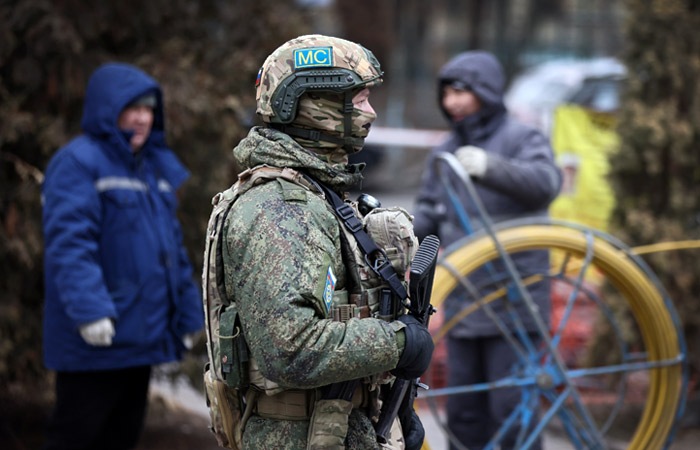
In January 2022, CSTO forces were deployed to Kazakhstan at the request of the government. Troops were airlifted to major airports and strategic facilities, temporarily assuming security roles that freed domestic forces for internal stabilization operations. The contingent withdrew within two weeks, but the operation demonstrated the logistical capability for rapid deployment and temporary control over key infrastructure.
Assessment and Future Trajectories
Russia maintains a direct military presence in Tajikistan and Kyrgyzstan and an indirect but substantial one in Kazakhstan. In Tajikistan and Kazakhstan there is precedent for intervention in domestic political crises.
Future developments will depend largely on the outcome of Russia’s confrontation with the West, particularly the war in Ukraine. A ceasefire or frozen conflict could increase the likelihood of renewed Russian strategic activity in Central Asia, either through political pressure on neighboring states or through attempts at deeper integration arrangements.
Russian military deployments generate direct pressure on host states and indirect pressure on neighboring ones. Over time, regional governments may attempt to diversify their security relations, while Moscow may attempt to reinforce its influence if conditions allow.
Paths Toward Reducing or Ending Russian Military Presence
Historical experience shows multiple strategies for reducing Russian military deployments. Central and Eastern European countries and the Baltic states achieved withdrawal through political consolidation and integration with Western institutions. Elsewhere, unresolved conflicts allowed Russia to maintain military footholds.
Azerbaijan demonstrated that legal and economic mechanisms can also be effective: after renegotiating lease terms, the Russian radar station at Gabala ceased operation.
Similar approaches could theoretically be applied in Central Asia, including renegotiation of leases or environmental and technical restrictions on testing facilities. The main obstacle, however, is political — dependence, security concerns, and fear of retaliation.
In Tajikistan and Kyrgyzstan, meaningful change would likely require political transformation and stronger regional cooperation to reduce vulnerability to external pressure. In Kazakhstan, reduction could occur through legal renegotiation and technical limitations on the operation of Russian dual-use facilities.
Ultimately, the question of reducing Russian military presence in Central Asia depends less on objective constraints than on political will and strategic vision within the region’s leaderships.
