
The change of regime in Afghanistan in 2021 not only fundamentally altered the trajectory of the country’s development but also became an important geopolitical factor affecting the future of both Central and South Eurasia.
This factor directly affects post-Soviet Central Asia (PSCA). Three states in the region—Turkmenistan, Uzbekistan, and Tajikistan—not only share borders with Afghanistan but are also linked to it through ethnic irredentas: communities of their respective titular nationalities that live compactly within Afghan territory.
Despite the controversial nature of Afghanistan’s new regime, which emerged from the Taliban movement, it should be viewed in geopolitical and historical terms primarily as another attempt by Afghans to govern their country independently rather than under foreign control. Two previous attempts in recent history failed:
- the period following the withdrawal of Soviet forces in 1992, when the mujahideen who had driven them out assumed power but failed to establish a consolidated regime or functioning state;
- the first period of Taliban rule from 1996 to 2001, during which the movement succeeded in establishing a consolidated regime but effectively made it hostage to international terrorist groups such as al-Qaeda, a development that ultimately led to the U.S. intervention and the de facto occupation of the country.
The periods
- 1979–1992, and
- 2001–2021
represent prolonged attempts to construct political regimes in Afghanistan under external geopolitical control—effectively occupation—by the Soviet Union and the United States respectively.
The establishment in 2021 of control over the entire territory of Afghanistan by the Islamic Emirate of Afghanistan, which continues to govern the country today, represents another attempt by Afghans themselves to manage their state. However, before assessing the prospects of this attempt—and the opportunities and risks it creates for Afghanistan and its neighbors—it is necessary to briefly outline the country’s political background and the historical context in which current developments are unfolding.
Afghanistan: A Brief History of Statehood

The history of Afghanistan as a unified polity dates back to the mid-eighteenth century, when Ahmad Shah Durrani first united the country’s various ethnic groups under a single authority. The largest of these groups were—and remain—the Pashtuns.
In the nineteenth century Afghanistan became an involuntary participant in the so-called Great Game—the geopolitical rivalry between the British and Russian Empires for influence in southern Eurasia. The country effectively became a buffer between the Russian and British geopolitical spheres. In order to avoid falling under British domination, Afghans fought a series of wars with Britain.
Although Britain ultimately failed to conquer Afghanistan, the Anglo-Afghan confrontation produced the enduring problem of the Durand Line. In 1893 the British established a border that effectively split the Pashtun ethnic territory roughly in half. This border was later inherited by Pakistan but has never been formally recognized by Afghanistan—neither under the monarchy, nor under republican governments, nor under the emirate.
Beginning in the early twentieth century, Afghan monarchs launched a series of modernization efforts. Among the most notable were the “rapid reforms” of Amanullah Khan (1919–1929) and the “gradual reforms of Mohammed Zahir Shah (1930–1973).
The coup carried out by the king’s cousin, Mohammed Daoud Khan, in 1973—presented as a republican revolution—effectively interrupted nearly a century of Afghanistan’s evolutionary development. During that earlier period the monarchy had managed to maintain a delicate balance:
- in domestic policy—between modernization in Kabul and the major cities and the preservation of traditional social structures in rural areas;
- in foreign policy—between the Western and Soviet blocs.
A few years of unstable republican rule destroyed this balance. In 1978 communists seized power in the so-called Saur Revolution, followed in 1979 by the Soviet invasion aimed at preserving and consolidating the communist regime.
The Soviet occupation of 1979–1992 and the resistance to it—supported by the broader Muslim world under the banner of jihad and assisted by Western countries—became the source of Afghanistan’s most dramatic long-term problems, the consequences of which the country continues to face today:
- the occupiers killed more than one million Afghans and left millions more wounded, orphaned, or displaced;
- fragile state and social institutions built during the twentieth century were destroyed;
- the natural balance between the modernized urban class and the religious rural population—previously sustained by a form of national consensus—collapsed.
Afghanistan that emerged after the expulsion of Soviet forces was born out of a religious liberation struggle and lacked genuine institutional continuity with the country’s earlier statehood. This created several major problems during the period 1992–1996:
- the absence of state consolidation, with military and tribal factions playing a decisive role instead of functioning state institutions;
- the emergence and growing influence of international groups pursuing destructive goals that ran counter to the interests of Afghanistan and the broader region;
- the marginalization of the modernist urban class, which had developed within a colonial rather than a national political framework.
As a result, Afghanistan after the Soviet withdrawal became a victim of internal fragmentation. This fragmentation was brought to an end only in 1996 by the emergence of a new type of religious movement—the Taliban—which rejected compromise with the modernized segment of society and with modernization-oriented development.
Close ties between the new regime and international terrorists from al-Qaeda after the attacks of September 11 led to another foreign intervention—this time by the Western coalition. Direct and indirect Afghan losses resulting from this intervention and the subsequent war amounted to roughly 300,000 deaths and about six million refugees.
However, the most serious strategic consequence for Afghanistan was another failed—and historically discredited—attempt at modernization. The Western coalition spent more than $2 trillion in Afghanistan, including investments in parts of the economy and social sectors and support for governmental and pro-government non-governmental structures. Yet the pro-Western authorities of the Islamic Republic of Afghanistan failed to build a consolidated national state. Instead, the regime survived primarily thanks to external support while becoming deeply corrupt and demoralized.
All of this ultimately led to the collapse of the pro-Western regime in 2021 and the return of the Taliban to power after the movement had carried out significant military, administrative, and political restructuring. A key element of this transformation was the leadership of the Islamic Emirate of Afghanistan 2.0 distancing itself from international terrorist groups and declaring its intention to respect international law.
This shift convinced the Western coalition that continued active confrontation with the Taliban was no longer feasible. As a result, negotiations began in Doha, which ultimately coincided with the accelerating collapse of the pro-Western Islamic Republic of Afghanistan and the establishment in 2021 of the Islamic Emirate of Afghanistan, which effectively governs the country today.
The Islamic Emirate of Afghanistan 2.0: Achievements, Problems, and Risks
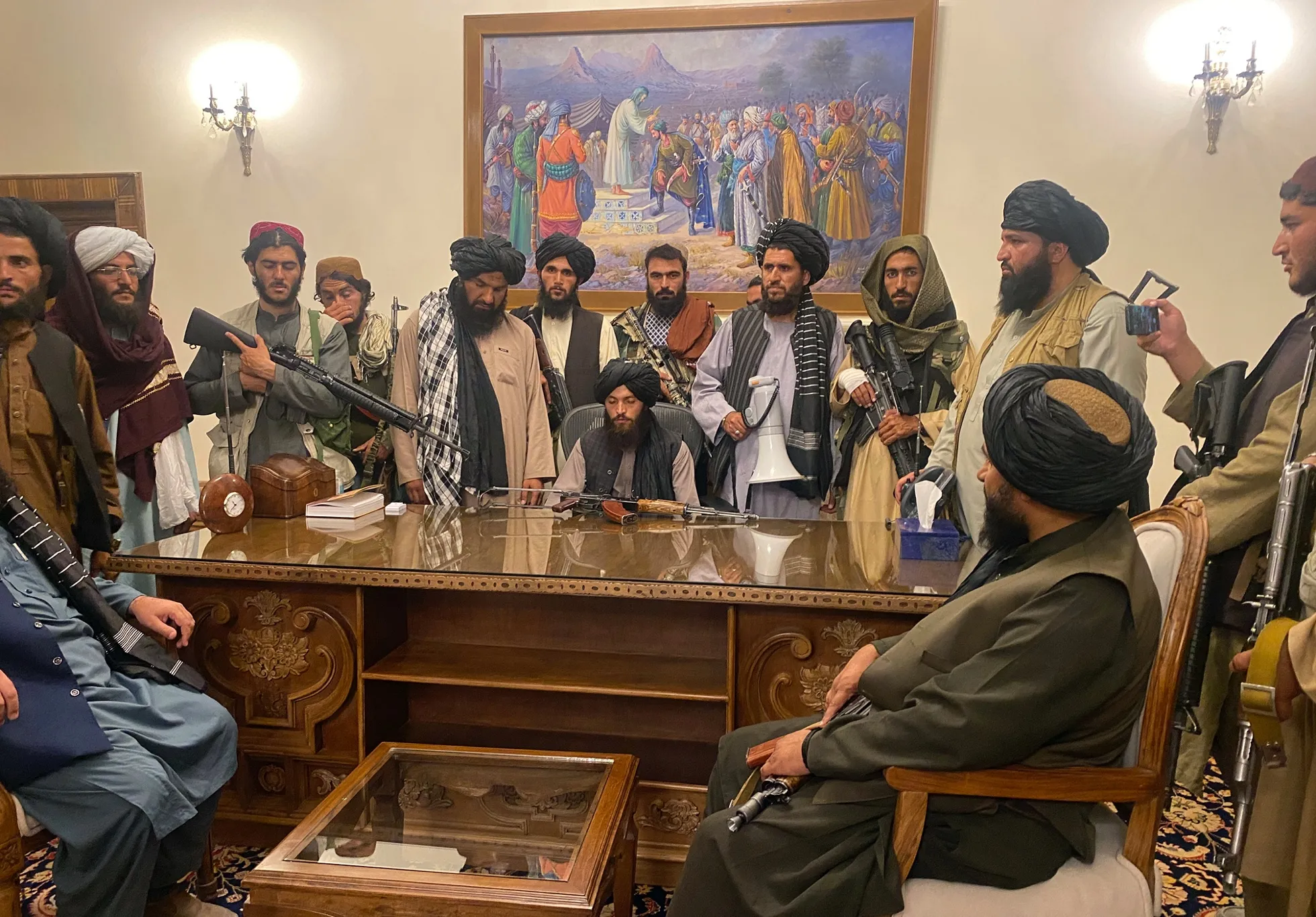
The Islamic Emirate of Afghanistan 2.0 has not only succeeded in establishing stable control over the country’s territory but has also avoided several mistakes made by its predecessors, including:
- actions of violence or cultural destruction that would shock the international community;
- open support for groups carrying out terrorist attacks against other countries and their citizens (the issue of the Pakistani Taliban will be discussed separately).
The authorities of the Islamic Emirate seek to establish pragmatic relations with other states while refraining from interference in their internal affairs. As a result, the new Afghan leadership has so far managed to prevent the country from sliding into chaos—as happened in 1992–1996—and has avoided provoking international intervention, as occurred in 2001.
At the same time, unlike in Syria—where forces of broadly similar ideological orientation came to power while preserving the internationally recognized framework of the Syrian Arab Republic and even conducting elections within it—the Taliban rejected the institutional framework of the internationally recognized Islamic Republic of Afghanistan and proclaimed a new state that remains largely unrecognized internationally.
As a result, the Islamic Emirate of Afghanistan lost access to the financial assets of the former Islamic Republic—effectively frozen by the United States—and became largely excluded from the global financial and monetary system. Consequently, the country’s economy is functioning in a survival mode:
- urban unemployment is estimated at 30–40 percent;
- roughly half the population periodically faces food shortages;
- many children suffer from chronic malnutrition and insufficient caloric intake.
Thus, the Taliban have so far managed to establish a stable political order and prevent large-scale chaos. However, Afghanistan under their rule faces serious economic and social challenges compounded by its difficult position in the international system.
Relations with PSCA States
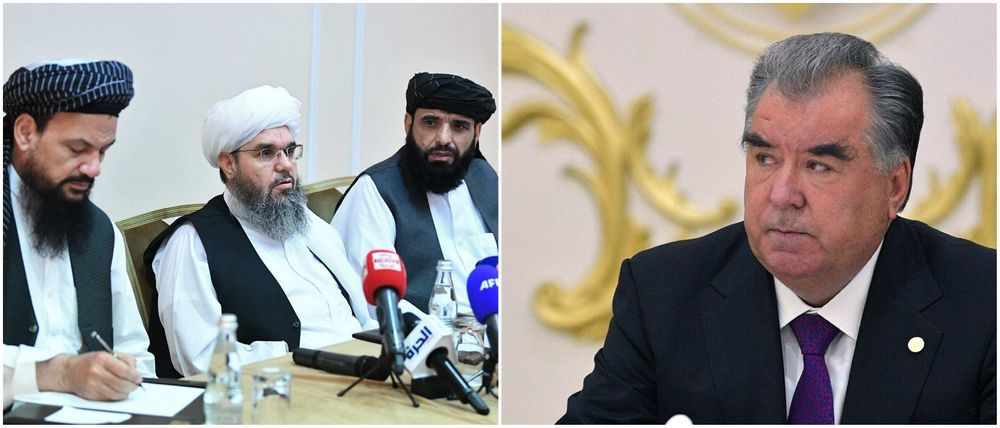
The states of post-Soviet Central Asia pursue different policies toward the Islamic Emirate of Afghanistan.
Tajikistan.
The Rahmon regime—one of the most dependent on Russian military support and therefore one of the most vulnerable—has adopted a nervous and openly hostile stance toward the new Afghan authorities.
Rahmon appears to see parallels between his own position as a ruler reliant on external military backing and the former Afghan regime. Consequently, he fears that the Taliban’s overthrow of that regime could inspire a similar scenario in Tajikistan. In addition, given the presence of ethnic Tajiks among the Taliban ranks, he fears the possibility that Afghan authorities could support Tajik militants seeking regime change in Tajikistan.
For these reasons the Rahmon government has repeatedly escalated tensions with Afghanistan while using these tensions to justify an expanded Russian military presence in the country—despite the fact that Russia itself is demonstratively developing relations with the Islamic Emirate.
Uzbekistan and Turkmenistan.
In contrast to Tajikistan, both states appear confident enough to develop pragmatic and mutually beneficial relations with Afghanistan. These include cooperation in transit, trade, electricity supplies, and even joint logistics and transport projects—such as the logistics hub in Termez and negotiations on the Termez–Mazar-i-Sharif–Kabul–Peshawar transport corridor.
Kazakhstan and Kyrgyzstan.
As countries without a direct border with Afghanistan, they pursue a relatively cautious policy. Kazakhstan seeks to maintain limited but direct economic contacts with Afghanistan, while Kyrgyzstan prefers to interact primarily through international organizations.
Pakistan: Afghanistan’s Main Neighbor and Main Challenge
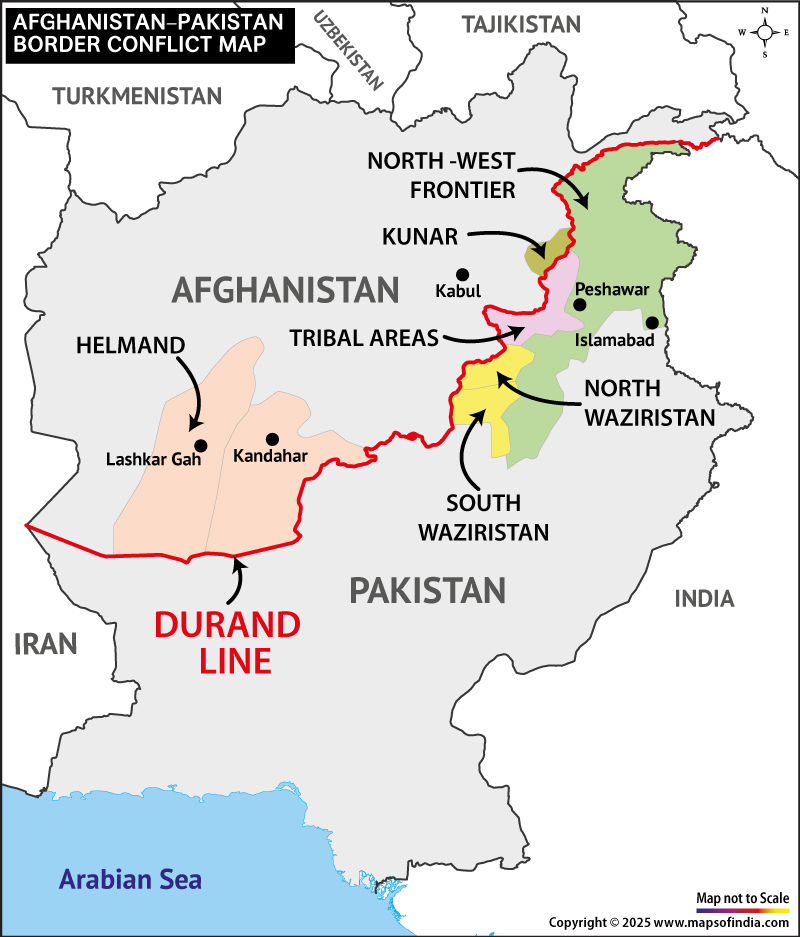
Pakistan has had the greatest influence among Afghanistan’s neighbors on the country’s modern political development.
During the Soviet occupation and the resistance against it, Pakistan served as the main rear base and organizational center for the Afghan resistance.
Similarly, during the war against the United States the Afghan Taliban used Pakistani border regions as rear areas—though in this case largely without Islamabad’s consent and thanks to cross-border Pashtun networks whose ethnic territory is divided by the Afghan-Pakistani border.
These same cross-border Pashtun connections today constitute one of the destabilizing factors in Afghan-Pakistani relations, as they form the social base of the Pakistani Taliban (Tehrik-i-Taliban Pakistan), which is waging an insurgency against the Pakistani government.
Although Afghanistan’s new authorities distance themselves from the activities of the Pakistani Taliban, Islamabad views Kabul’s inability—or unwillingness—to suppress the group’s operations on Afghan territory as a casus belli.
This has already led to military clashes between Pakistan and Afghanistan and may further destabilize both countries in the future.
The Impact of Afghanistan’s Political Transformation on PSCA
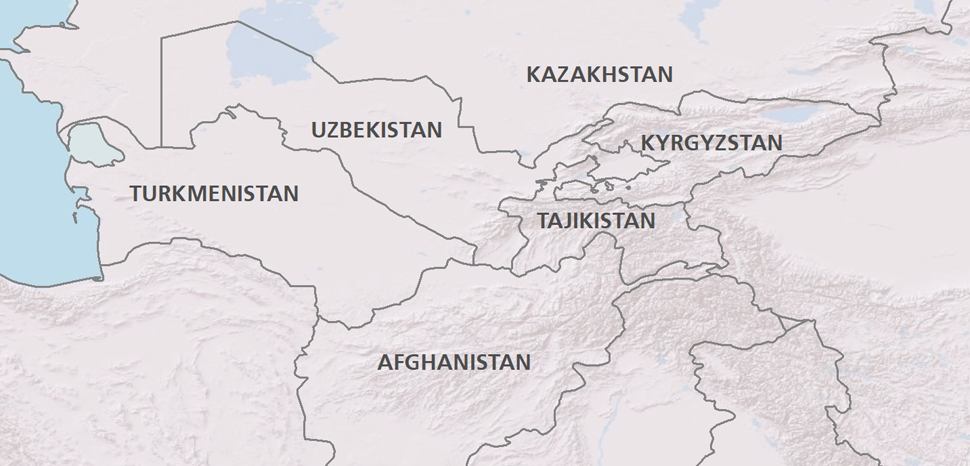
Although the new Afghan authorities emphasize their non-interference in the internal affairs of neighboring states and their desire to develop mutually beneficial cooperation, the very precedent of regime change through armed struggle in a neighboring country cannot but influence political attitudes within PSCA societies.
This is especially true for states bordering Afghanistan whose ethnic kin live in large numbers within Afghan territory. The most sensitive case is Tajikistan, whose regime depends heavily on external—primarily Russian—support, including military backing.
Given Russia’s growing geopolitical difficulties, it cannot be excluded that at some point Moscow may lose either the capacity or the willingness to sustain the Rahmon regime. Under such circumstances, the Afghan authorities could potentially support political change in neighboring Tajikistan.
Such a scenario is less likely in Uzbekistan and Turkmenistan, whose governments have prudently established pragmatic relations with the new Afghan authorities.
At the same time, the opposite scenario must also be considered: the destabilization of Afghanistan itself as a result of accumulating economic and social pressures, growing confrontation with Pakistan, or even a new international intervention. In such a situation, Afghan territory—no longer controlled by a government seeking pragmatic relations with its neighbors—could become a base for more radical and destructive groups, creating serious security risks for PSCA states.
In any case, Afghanistan’s recent history illustrates the dangers of deep internal divisions, externally imposed regimes established by force, and the marginalization of large segments of society. At the same time, it demonstrates how determined social forces within a nation may mobilize to resist such conditions. This experience is essential to consider when assessing the future trajectory of the states of post-Soviet Central Asia.
